
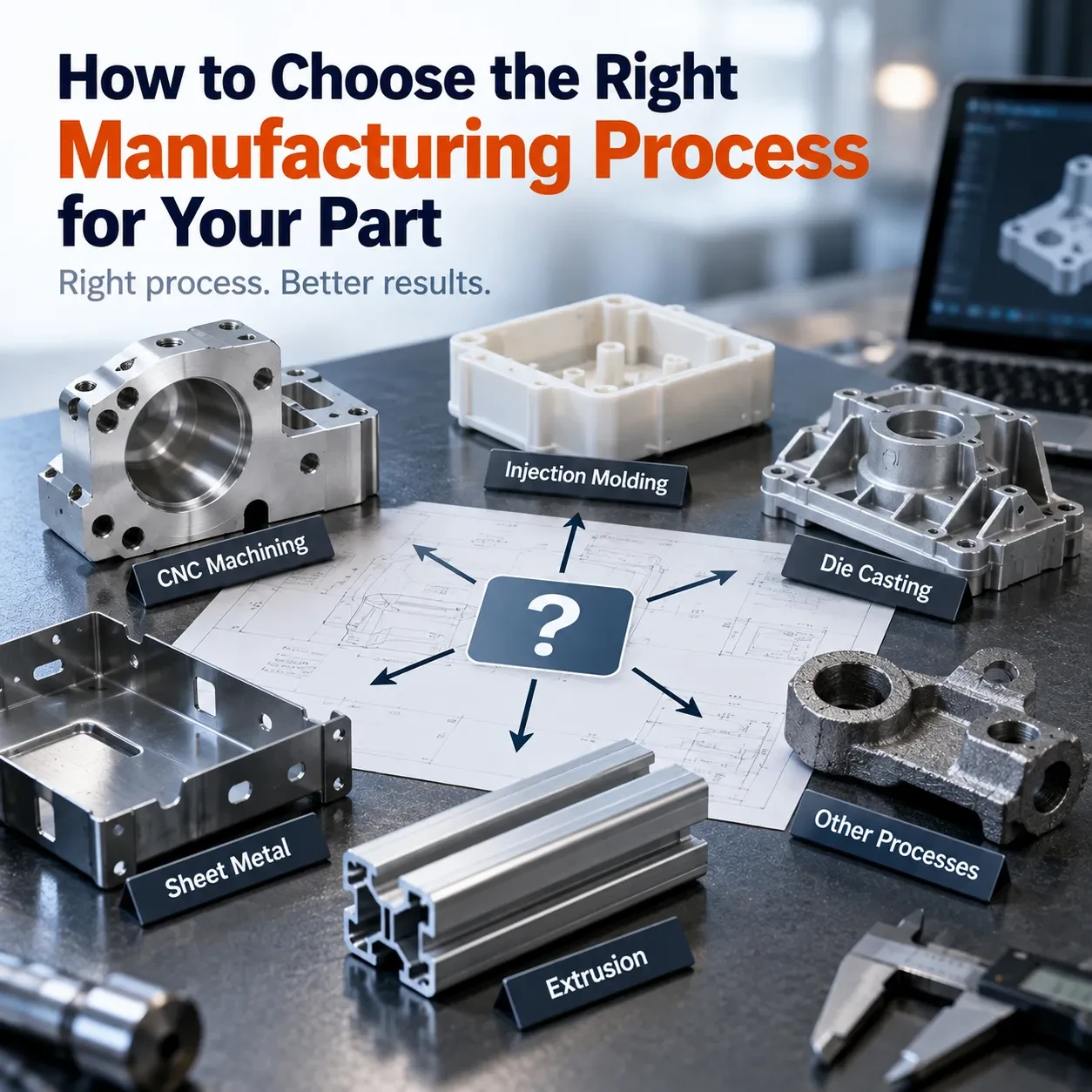
Guide 26: How to Choose the Right Manufacturing Process for Your Part
Choosing the right manufacturing process is critical for balancing part performance, production volume, lead time, and cost. This guide breaks down the core factors to consider—including key evaluation questions, comparisons of major processes (CNC Machining, 3D Printing, Injection Molding, Sheet Metal Fabrication, Vacuum Casting, Die Casting, and Aluminum Extrusion), common selection pitfalls, and best practices to help you optimize production from prototyping to mass manufacturing.
Guide 26: How to Choose the Right Manufacturing Process for Your Part
How to Match Part Geometry, Volume, Cost & Performance to the Right Process | Manufacturing Academy
You've finished your product design, created the 3D CAD model, and are ready to move into manufacturing.
Now comes one of the most important decisions in product development: Which manufacturing process should you choose?
The answer isn't always obvious. A process that's ideal for one part may be too expensive, too slow, or simply unsuitable for another. Choosing the wrong process can increase costs, delay production, and even compromise product performance.
Whether you're developing a prototype, launching a new product, or scaling to mass production, understanding the strengths and limitations of each manufacturing method helps you make better decisions from the start.
In this guide, we'll compare the most common manufacturing processes and explain when each one makes the most sense.
1. Start with These Five Questions
Before comparing manufacturing methods, ask yourself:
· What material does the part require? (Metals, engineering plastics, elastomers)
· How many parts do you need? (Prototypes, low-volume, mass production)
· What level of precision is required? (Tight tolerances vs. standard commercial tolerances)
· How complex is the geometry? (Flat profiles, folded sheets, uniform profiles, 3D organic shapes)
· What is your target cost and lead time? (Upfront tooling budget vs. per-part cost)
The answers will quickly narrow your options.
2. Common Manufacturing Processes at a Glance
Process | Best For | Typical Volume |
CNC Machining | Precision metal & plastic parts | 1–10,000 |
3D Printing | Rapid prototypes & complex geometries | 1–100 |
Injection Molding | Plastic production parts | 1,000+ |
Vacuum Casting | Low-volume plastic parts | 10–100 |
Sheet Metal Fabrication | Enclosures, brackets & panels | 10–10,000 |
Die Casting | High-volume metal components | 5,000+ |
Aluminum Extrusion | Long, constant-profile parts | 500+ |
3. Detailed Breakdown of Manufacturing Processes
CNC Machining
Best for: High precision, metal components, engineering plastics, functional prototypes, low- to medium-volume production.
Advantages:
· Excellent dimensional accuracy and tight tolerances
· Wide range of material compatibility (metals and plastics)
· Superior surface finishes
· No initial tooling investment
· Fast design changes
Limitations:
· Higher cost per part for very large production volumes
· Material waste due to subtractive machining
· Internal geometries may have tooling access limitations
Typical Applications: Aerospace components, medical devices, robotics, industrial machinery, automotive prototypes, custom fixtures.
3D Printing (Additive Manufacturing)
Best for: Concept models, functional prototypes, complex internal structures, fast design validation.
Advantages:
· No tooling required
· Very short lead times
· Complex organic geometries and lattice structures possible
· Ideal for iterative design testing
Limitations:
· Lower dimensional accuracy and mechanical strength compared to CNC
· Limited end-use material options
· Surface finish often requires post-processing
· Not economical for high-volume production
Typical Applications: Product development, fit and assembly testing, design verification, low-volume custom parts.
Injection Molding
Best for: Plastic production parts, high-volume manufacturing, consumer products.
Advantages:
· Lowest cost per part at high volumes
· Excellent repeatability and consistent quality
· Fast production cycle times (seconds per part)
· High-quality cosmetic finishes and textures
Limitations:
· High mold/tooling investment
· Longer tooling lead times (weeks to months)
· Design changes become expensive after mold completion
Typical Applications: Consumer electronics enclosures, household products, medical disposables, automotive interiors.
Vacuum Casting
Best for: Bridge production, low-volume plastic parts, pre-production functional testing.
Advantages:
· Significantly lower tooling cost than injection molding
· Good cosmetic quality and surface detail
· Fast turnaround (days to weeks)
· Suitable for multiple polyurethane material simulations
Limitations:
· Silicone molds have a limited lifespan (approx. 20–25 cycles per mold)
· Higher unit cost than injection molding at volume
· Dimensional consistency decreases over many cycles
Typical Applications: Pilot production, marketing samples, user testing, short production runs.
Sheet Metal Fabrication
Best for: Flat metal components, cabinets, brackets, electrical enclosures.
Advantages:
· High material efficiency with minimal scrap
· Fast fabrication speed
· Excellent strength-to-weight ratio
· Scalable production from prototype to batch sizes
Limitations:
· Limited to formed sheet stock materials
· Complex 3D features may require secondary machining or assembly
Typical Applications: Server racks, control cabinets, machine guards, HVAC components, industrial equipment.
Die Casting
Best for: High-volume metal production, aluminum and zinc structural components, thin-wall parts.
Advantages:
· Low unit cost at high production scales
· Fast production cycle times
· Good surface finish and complex exterior shapes
· Consistent dimensional quality
Limitations:
· High steel tooling investment
· Limited alloy selection (primarily aluminum, zinc, magnesium)
· Design changes are costly after tool build
Typical Applications: Automotive housings, consumer electronics frames, power tool bodies, lighting fixtures.
Aluminum Extrusion
Best for: Long components with constant cross-sectional profiles.
Advantages:
· Excellent material utilization and minimal waste
· Low cost for long linear profiles
· Lightweight structural shapes
· Consistent cross-sectional quality
Limitations:
· Cross-section must remain uniform throughout the length
· Secondary machining (CNC) is often required for holes, pockets, and ends
Typical Applications: Heat sinks, structural framing, rails, automation equipment.
4. Comparing the Processes
Factor | CNC Machining | 3D Printing | Injection Molding | Sheet Metal | Die Casting |
Precision | Excellent | Good | Excellent | Good | Good |
Tooling Cost | None | None | High | Low | High |
Production Speed | Medium | Fast | Very Fast | Fast | Very Fast |
Design Flexibility | Excellent | Excellent | Moderate | Good | Moderate |
Best Volume | Low–Medium | Very Low | High | Medium–High | High |
Material Variety | Excellent | Moderate | Plastics Only | Sheet Metals | Limited Alloys |
5. Can Multiple Processes Be Combined?
Absolutely. Many successful commercial products utilize several manufacturing methods together to optimize cost, aesthetics, and structural performance.
Example Assembly:
· CNC-machined aluminum chassis/housing
· Injection-molded plastic top cover
· Sheet metal mounting bracket
· Extruded aluminum heat sink
· Rubber overmolded seals
· Standard fasteners and hardware
6. Common Mistakes When Choosing a Process
· Selecting a process based only on part price: Ignoring tooling costs or setup fees can distort the total unit cost calculation.
· Designing without considering production volume: Over-engineering a prototype for mass tooling before design freeze.
· Choosing unnecessarily tight tolerances: Requesting tolerances tighter than functionally required increases machining cost exponentially.
· Overlooking assembly requirements: Not considering how individual parts mate and integrate.
· Delaying manufacturing discussions: Waiting until design finalization to consult with manufacturing engineers.
7. Best Practices
· Define expected production volumes across the full product lifecycle early.
· Select materials prior to locking in the manufacturing process.
· Balance total unit cost, tooling cost, precision, and lead time holistically.
· Request Design for Manufacturability (DFM) feedback before releasing engineering drawings.
· Partner with a manufacturing provider offering multiple processes to avoid bias toward a single method.
8. Conclusion & Key Takeaways
Choosing the right manufacturing process directly dictates cost, quality, lead time, and scalability. Ask yourself: "Which process is best for this specific part, at this volume, within this budget?"
· No single process fits every part.
· Volume is usually the primary factor governing the economical transition between processes.
· CNC Machining offers supreme flexibility and precision without upfront tooling.
· Injection Molding and Die Casting dominate high-volume production efficiency.
· Sheet Metal and Extrusion provide optimized material efficiency for structural and linear geometries.
9. Ready to Choose the Best Manufacturing Process?
Not sure which process best fits your project?
Want this reviewed on your own part?
Upload your CAD file for a free DFM review. Our engineering team will assess manufacturability, material and process options, and cost drivers for your design.
Get a Free DFM Review