
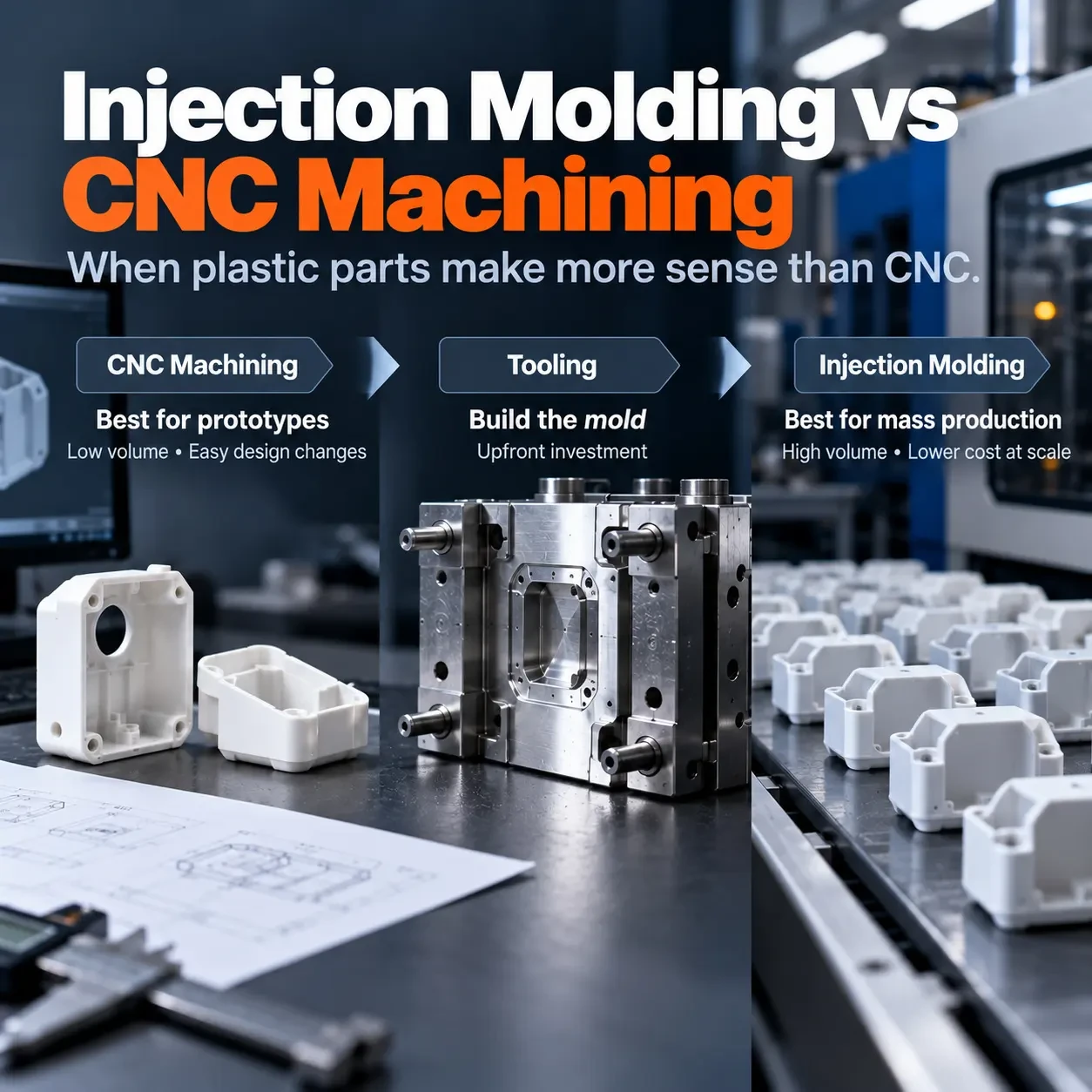
Guide 27: Injection Molding Explained: When Plastic Parts Make More Sense Than CNC
This guide explains the key differences between CNC machining and injection molding for plastic parts. It breaks down how injection molding works, common plastics used, key advantages and limitations, and volume thresholds (when to switch from CNC/3D printing to injection molding). It also provides crucial Design for Manufacturability (DFM) tips to help you choose the right process and reduce production costs.
Guide 27: Injection Molding Explained: When Plastic Parts Make More Sense Than CNC
When Plastic Parts Make More Sense Than CNC | Manufacturing Academy
You've designed a plastic part and now need to decide how to manufacture it. Should you machine it from a solid plastic block using CNC, or invest in an injection mold for mass production?
The answer depends on more than just the material. Production volume, part geometry, lead time, tooling budget, and long-term manufacturing costs all play a role.
While CNC machining is often the fastest option for prototypes and low-volume production, injection molding becomes significantly more cost-effective once production scales up.
Understanding when to transition from CNC machining to injection molding can save thousands of dollars and shorten production cycles. In this guide, we'll explain how injection molding works, compare it with CNC machining, and help you determine which process is the better choice for your project.
1. What Is Injection Molding?
Injection molding is a manufacturing process in which molten plastic is injected into a precision-machined steel or aluminum mold under high pressure.
After the plastic cools and solidifies, the mold opens, ejecting a finished part that is ready for use or minimal post-processing.
Unlike CNC machining, which removes material from a solid block, injection molding forms the part directly inside the mold cavity. This makes it one of the fastest and most efficient manufacturing methods for plastic components.
2. How the Injection Molding Process Works
The basic process consists of five steps:
· Plastic pellets are loaded into a hopper and heated in a barrel until they melt.
· Molten plastic is injected under high pressure into the closed mold cavity.
· Cooling: The material cools and solidifies, taking the exact shape of the mold.
· Ejection: The mold opens and ejector pins push the finished part out.
· Cycle repetition: The mold closes and the cycle repeats, often in less than 60 seconds.
3. Common Plastic Materials
Material | Typical Applications |
ABS | Consumer products, electronics housings, automotive trim |
PC (Polycarbonate) | Transparent covers, lenses, impact-resistant structural parts |
Nylon (PA / PA66) | Gears, bearings, wear pads, industrial structural parts |
POM (Acetal / Delrin) | Precision mechanical parts, low-friction bushings |
PP (Polypropylene) | Containers, living hinges, medical items, chemical tanks |
PE (Polyethylene) | Packaging, bottles, piping, flexible components |
TPU | Flexible components, overmolded grips, seals, gaskets |
PEEK | Aerospace components, medical implants, high-temperature environments |
4. Advantages of Injection Molding
· Extremely Low Cost Per Part: At volume, automated cycles make unit costs fractional compared to machining.
· Excellent Repeatability: Mold dimensions guarantee identical part-to-part geometry and tight tolerances across millions of parts.
· Complex Geometries & Features: Features like snap fits, living hinges, internal ribbing, bosses, and thin walls can be molded in a single step.
· High Production Speed: Cycle times range from 15 to 60 seconds per shot.
· Superior Cosmetic Finishes: Surface textures (high gloss, matte, leather grain, molded logos) are formed directly by the mold finish.
5. Limitations of Injection Molding
· High Initial Tooling Cost: Precision steel or aluminum molds require significant upfront investment ($3,000 to $100,000+).
· Longer Lead Time: Tooling design, machining, polishing, and sampling require several weeks before initial production.
· Costly Design Modifications: Modifying a finished steel mold requires EDM, re-machining, or new inserts, making engineering changes expensive.
6. CNC Machining vs. Injection Molding Comparison
Factor | CNC Machining | Injection Molding |
Best Volume | 1–1,000 parts | 1,000+ parts |
Tooling Cost | None | High ($3k–$100k+) |
Cost Per Part | Higher (constant) | Very Low at Scale |
Design Changes | Easy (program update) | Expensive (mold modification) |
Lead Time | Fast (days) | Longer (weeks for tooling) |
Material Waste | Higher (chips/scrap) | Lower (recyclable runners) |
Molded Features | Limited by tool access | Excellent (thin walls, ribs, clips) |
7. When Does Injection Molding Become More Economical?
Annual Production Quantity | Recommended Process |
1–50 units | 3D Printing / Additive Manufacturing |
50–500 units | CNC Machining |
100–2,000 units | Vacuum Casting or Soft Aluminum Bridge Tooling |
2,000+ units | Production Injection Molding |
8. Design Tips for Injection Molding (DFM)
· Maintain uniform wall thickness to prevent sink marks and warping.
· Incorporate draft angles (1° to 2°) on vertical walls for smooth part ejection.
· Use ribs and gussets to add structural strength instead of thick solid sections.
· Avoid unnecessary undercuts that require complex side-actions or lifters.
· Apply generous radii to inside corners to reduce stress concentrations.
9. Can CNC and Injection Molding Work Together?
Yes. Many successful products move through a clear progressive lifecycle:
· Prototype: 3D printing for initial visual and ergonomic evaluation.
· Engineering Validation: CNC-machined plastic parts for functional testing and fit checks.
· Pilot Production: Vacuum casting or rapid aluminum tooling for market testing.
· Mass Production: Production steel injection mold for high-volume delivery.
10. Conclusion & Key Takeaways
· Injection Molding delivers unrivaled low unit costs, repeatability, and speed at scale.
· CNC Machining is superior for functional prototypes, design changes, and production volumes under 500–1,000 units.
· Transitioning at the right volume milestone maximizes margin while mitigating tooling risk.
11. Need Help Choosing Between CNC and Injection Molding?
Our engineering team can evaluate your CAD model, estimate manufacturing costs across various volumes, and recommend the optimal production roadmap.
Want this reviewed on your own part?
Upload your CAD file for a free DFM review. Our engineering team will assess manufacturability, material and process options, and cost drivers for your design.
Get a Free DFM Review