
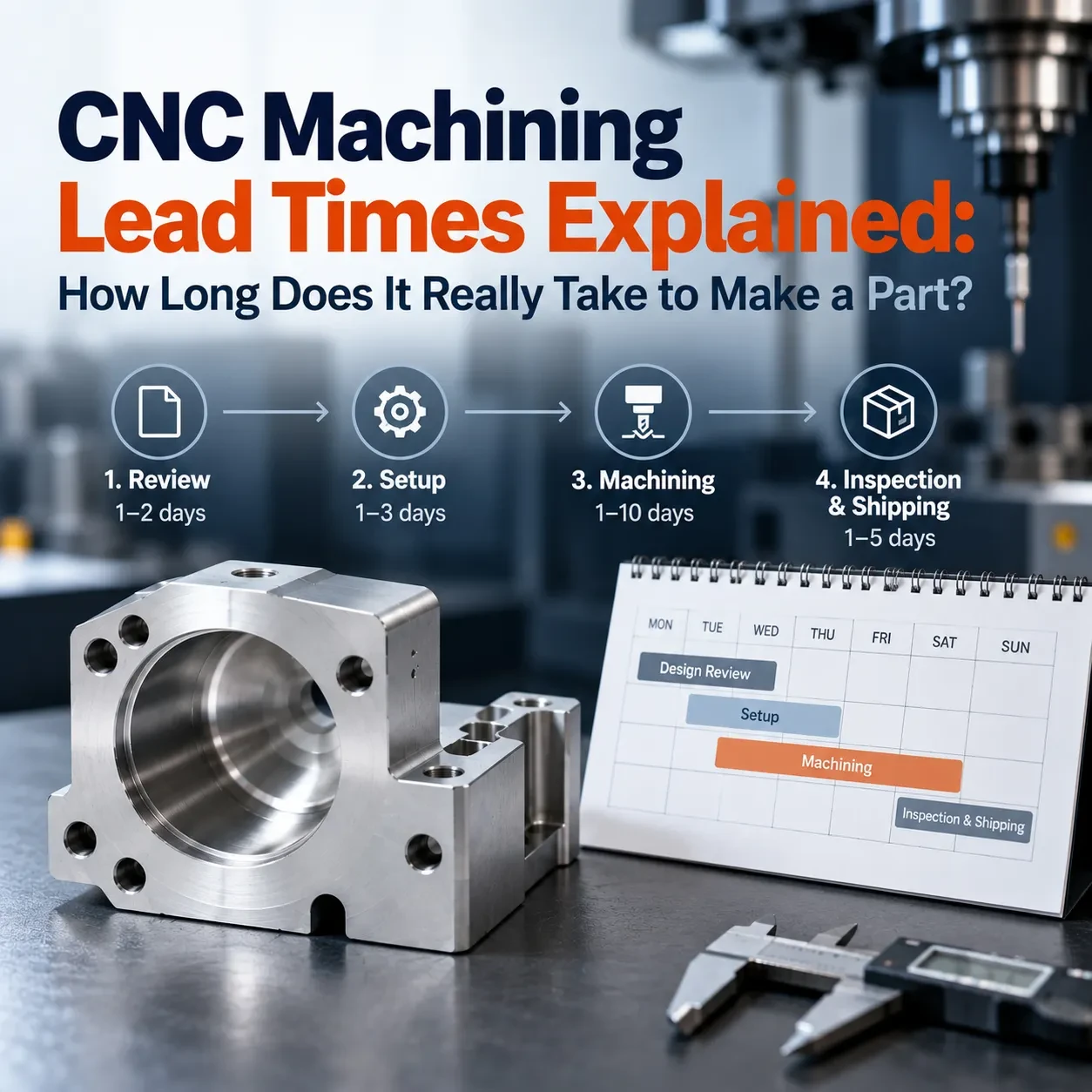
Guide 25: CNC Machining Lead Times Explained: How Long Does It Really Take to Make a Part?
CNC machining lead time involves far more than just machine run time. Total delivery schedules depend on engineering reviews, material procurement, CAM programming, setup, quality inspection, surface treatments, and final shipping. By selecting standard stock materials, relaxing non-critical tolerances, and addressing DFM feedback early, engineering teams can significantly reduce lead times and stay on schedule.
Guide 25: CNC Machining Lead Times Explained: How Long Does It Really Take to Make a Part?
What Determines Delivery Time from Order to Finished Parts | Manufacturing Academy
One of the first questions customers ask after requesting a quotation is: "When can I get my parts?"
The answer depends on much more than the machining process itself. A part that takes only 30 minutes to machine may still require several days before it ships. Material sourcing, engineering review, machine scheduling, quality inspection, surface finishing, and logistics all contribute to total lead time.
1. What Is CNC Machining Lead Time?
Lead time is the total time from placing an order to receiving finished parts. The 8 key steps in a typical CNC timeline are:
· Engineering Review: Evaluating CAD models, drawings, tolerances, materials, and performing DFM review.
· Material Procurement: In-stock materials move fast; specialized or custom alloys add procurement lead time.
· CAM Programming: Generating toolpaths and G-code for complex multi-axis parts.
· Machine Setup: Installing fixtures, soft jaws, cutting tools, and setting work offsets.
· CNC Machining: Cutting material according to optimized CAM programs.
· Inspection & Quality Control: Dimensional checks, FAI, and CMM inspection.
· Surface Finishing: Secondary operations such as anodizing, plating, or painting.
· Packaging & Shipping: Protective packaging, labeling, and freight delivery.
2. Factors That Affect Lead Time
· Part Complexity: Multi-axis setups and deep features require longer programming and machining times.
· Material Availability: Common stock (e.g. Aluminum 6061) is immediate; specialty metals/plastics take time to source.
· Production Quantity: Larger order quantities increase total machine hours, though unit time drops.
· Tolerance Requirements: Extremely tight tolerances require slower machining feeds and rigorous inspection.
· Surface Finishing: Secondary treatments (anodizing, powder coating) add 3–7 business days.
3. Typical Lead Time Expectations
Project Type | Typical Lead Time |
Rapid Prototypes (In-stock material) | 3–5 Business Days |
Standard Production (Low-Medium Volume) | 10–15 Business Days |
Complex / Multi-Operation Parts with Finishing | 15–20 Business Days |
4. How to Shorten CNC Lead Times
· Choose standard, readily available raw materials.
· Incorporate DFM feedback early to avoid design holds.
· Relax non-critical tolerances to speed up machining and inspection.
· Select standard surface finishes or skip cosmetic treatments if not needed.
· Consolidate orders and communicate production forecasts early.
5. Conclusion
Understanding all steps in the CNC manufacturing timeline helps you set realistic expectations and optimize product launch schedules. Partnering with a reliable manufacturer ensures transparent timelines and on-time delivery.
Key Takeaways
· CNC lead time includes engineering, procurement, setup, machining, inspection, finishing, and shipping.
· Material choice, part complexity, tolerances, and surface finishing directly affect delivery time.
· Using standard materials and simplifying design features can significantly shorten lead times.
· Early communication and reliable partner selection prevent unnecessary project delays.
Accelerate Your Production Timeline:
Want to eliminate lead-time bottlenecks and optimize your component designs before production?
Submit your CAD drawings for a complimentary CNC DFM Review today.
Our technical team will analyze your part geometry, suggest cost-saving tweaks, and deliver actionable engineering feedback.
Want this reviewed on your own part?
Upload your CAD file for a free DFM review. Our engineering team will assess manufacturability, material and process options, and cost drivers for your design.
Get a Free DFM Review