
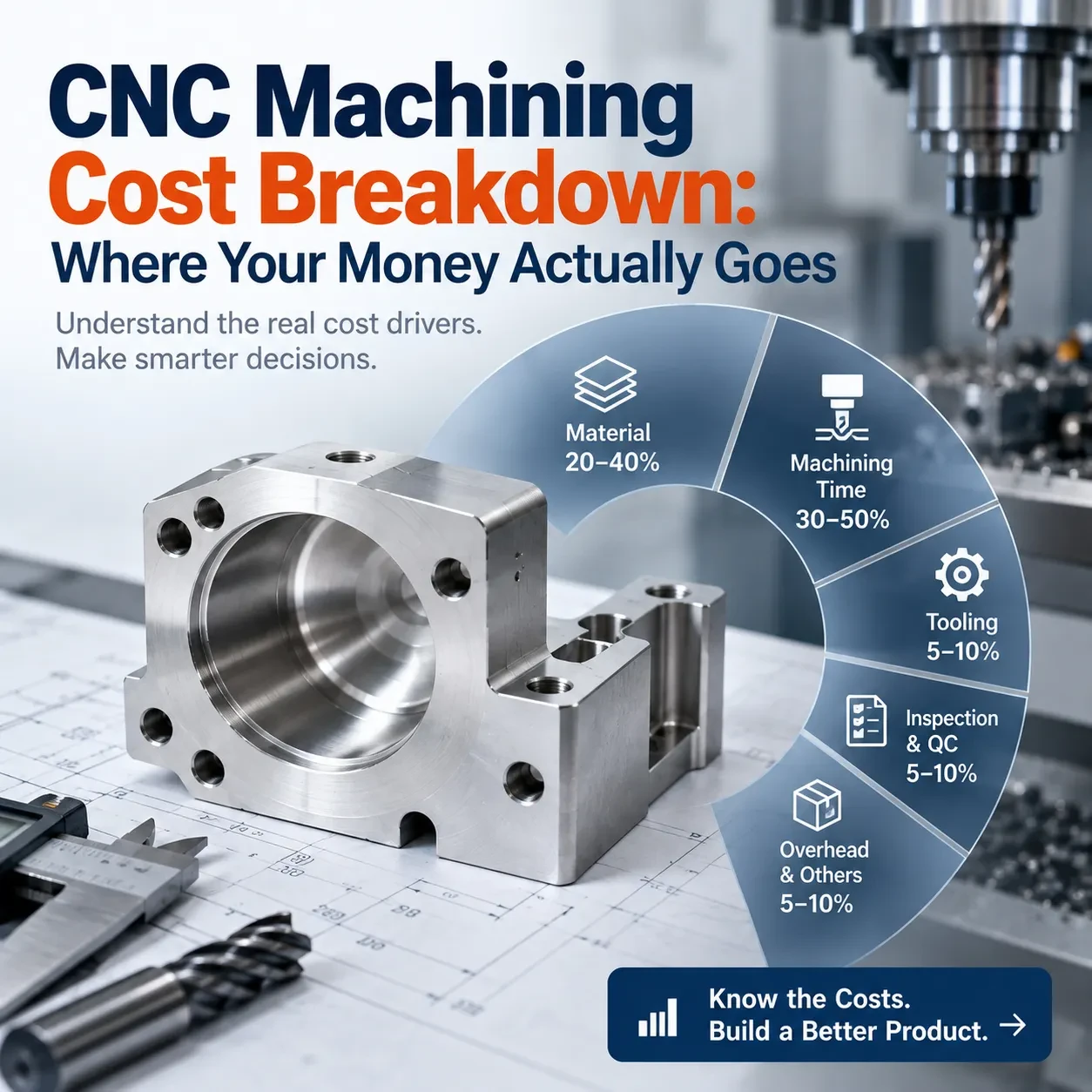
Guide 24: CNC Machining Cost Breakdown: Where Your Money Actually Goes
Understanding CNC machining costs goes beyond raw material expenses. A typical quote factors in setup and CAM programming, machine running time, specialized cutting tools, quality control, surface finishing, and shipping. By optimizing designs with standard radii, relaxed tolerances, and practical batch sizes, engineers can significantly reduce unit costs while ensuring high precision and reliable quality.
Guide 24: CNC Machining Cost Breakdown: Where Your Money Actually Goes
Where Your Money Actually Goes | Manufacturing Academy
One of the most common questions buyers ask is: "Why does this CNC part cost so much?"
At first glance, a machined component may seem simple—a small aluminum bracket or a stainless steel shaft. However, the price reflects far more than raw material. Every CNC quote includes multiple cost elements, from programming and machine time to tooling, inspection, finishing, and logistics.
1. The Anatomy of a CNC Machining Quote
Most CNC machining costs fall into six major categories:
Material Cost
Total material cost depends on material type, stock size, availability, and waste generated during cutting.
Material | Relative Cost |
Aluminum 6061 | Low |
Mild Steel | Low |
Stainless Steel 304 | Medium |
Brass | Medium |
Titanium | High |
PEEK | Very High |
Programming and Setup
Preparation activities include CAD review, CAM toolpath creation, tool selection, fixture installation, work offset setting, and trial runs. Because setup is a one-time activity, cost per part drops sharply as order quantity increases.
Machine Time
Machine running time is usually the largest cost driver. Factors increasing machine time include deep pockets, small tools, 3D surfaces, multiple setups, tight tolerances, and tough materials.
Cutting Tools and Consumables
Harder materials accelerate tool wear. Tooling costs include end mills, drills, reamers, inserts, taps, coolant, and tool holders.
Inspection and Quality Control
Verification activities: First Article Inspection (FAI), in-process measurements, final dimensional checks, surface finish checks, and material certification reports.
Surface Finishing and Logistics
Secondary processes such as anodizing, powder coating, bead blasting, passivation, polishing, electropolishing, or black oxide add processing time, transport, and extra inspection.
2. Other Influencing Factors & Cost Reduction
Order Quantity | Cost per Part Impact |
1 pc | Highest (Setup cost concentrated on 1 unit) |
10 pcs | Lower |
100 pcs | Lower still |
1,000 pcs | Much lower |
Practical Cost-Reduction Strategies:
· Use standard materials whenever possible.
· Avoid unnecessarily tight tolerances.
· Increase internal corner radii and standardize hole sizes.
· Minimize unnecessary cosmetic features.
· Design for fewer setups and order economical batch quantities.
· Allow standard production lead times (avoid rush orders).
· Request a DFM review before production.
3. Conclusion
A CNC machining quote represents far more than raw material cost. Evaluate suppliers based on engineering feedback, stable quality, and total project savings rather than just the lowest initial price tag.
Key Takeaways
· CNC machining costs include material, setup, machine time, tooling, inspection, finishing, and logistics.
· Machine time is often the largest contributor to the final price.
· Part complexity, tolerances, material choice, and order quantity significantly influence cost.
· Design for Manufacturability (DFM) can reduce machining time and lower production costs.
· Evaluate suppliers based on engineering support, quality, and reliability—not just the lowest quote.
Before submitting your project for cost estimation, ensure your documentation is complete.
Want this reviewed on your own part?
Upload your CAD file for a free DFM review. Our engineering team will assess manufacturability, material and process options, and cost drivers for your design.
Get a Free DFM Review