
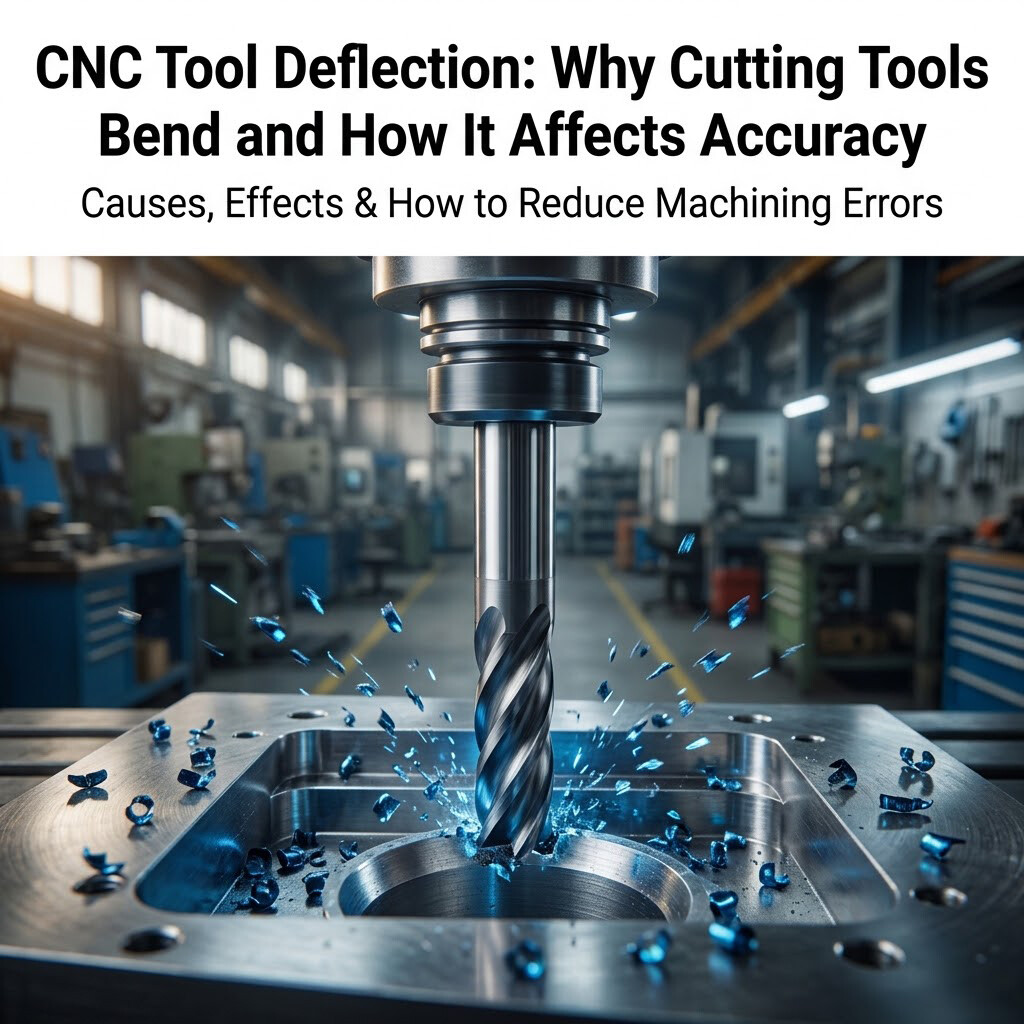
Guide 18: CNC Tool Deflection: Why Cutting Tools Bend and How It Affects Part Accuracy
Tool deflection is the temporary bending of a CNC cutting tool under machining loads, leading to dimensional errors and poor surface finishes. It is primarily caused by excessive tool length, small diameters, and high cutting forces. You can minimize deflection and improve part accuracy by using shorter tools, rigid carbide materials, and optimized cutting parameters.
Guide 18: CNC Tool Deflection: Why Cutting Tools Bend and How It Affects Part Accuracy
Causes, Effects & How to Reduce Machining Errors | Manufacturing Academy
1. Introduction
Many designers assume that a CNC cutting tool is perfectly rigid. In reality, every cutting tool bends—sometimes by only a few microns, sometimes by enough to ruin an entire part.
This phenomenon is known as tool deflection, and it is one of the most common causes of dimensional errors, poor surface finishes, excessive tool wear, and inconsistent machining results.
Understanding why tool deflection occurs helps engineers design parts that are easier to machine, achieve tighter tolerances, and reduce manufacturing costs.
2. What Is Tool Deflection?
Tool deflection is the elastic bending of a cutting tool caused by machining forces. As the cutter removes material, cutting forces push against the tool. Instead of remaining perfectly straight, the tool bends slightly away from the cutting force. After the force is removed, the tool returns to its original shape. Unlike permanent damage, tool deflection is temporary—but its effects on the finished part can be significant.
3. Why Does Tool Deflection Matter?
Even a small amount of bending can change the position of the cutting edge. The result may include:
• Undersized or oversized features
• Tapered walls
• Poor dimensional accuracy
• Inconsistent pocket sizes
• Rough surface finish
• Excessive vibration
• Shorter tool life
The deeper the cut and the longer the tool, the greater the potential for deflection.
4. What Causes Tool Deflection?
Tool Length
Long tools behave like long beams. The farther the cutting edge extends from the spindle, the easier it is to bend. For this reason, machinists always try to use the shortest tool possible.
Tool Diameter
Small-diameter end mills are much less rigid than larger ones. For example, a 3 mm end mill deflects much more than a 12 mm end mill under the same cutting load. Miniature tools require lighter cuts and slower material removal rates.
Cutting Force
Higher cutting forces create greater bending. Cutting force increases with deeper cuts, wider cuts, harder materials, dull tools, and aggressive feed rates. Reducing cutting force usually reduces deflection.
Tool Material
Different tool materials have different stiffness. Common examples include:
• Solid carbide: Very rigid and ideal for precision machining.
• High-speed steel (HSS): Less rigid but more forgiving in some applications.
Carbide tools are widely used because they resist deflection better than HSS.
5. How Tool Deflection Affects Part Accuracy
Tool deflection rarely produces random errors. Instead, it often creates predictable machining problems:
• Oversized or Undersized Features: As the tool bends, the cutting edge moves away from its programmed path. This may produce pockets that are too small, slots that are too narrow, or external profiles that are oversized.
• Tapered Walls: Long tools tend to bend more at greater depths. As a result, vertical walls may become slightly tapered rather than perfectly straight, especially in deep cavities.
• Poor Surface Finish: A vibrating or deflecting tool leaves visible chatter marks, waviness, inconsistent finishes, and visible tool lines.
• Reduced Tool Life: Repeated bending increases mechanical stress on the cutter, leading to edge chipping, premature wear, or broken end mills.
6. Signs of Excessive Tool Deflection
Machinists often recognize deflection before measuring the finished part. Common warning signs include unusual vibration, squealing during cutting, inconsistent cutting sound, poor surface finish, unexpected dimensional variation, and broken small-diameter tools.
7. How Machinists Reduce Tool Deflection
• Use the Shortest Possible Tool: Reducing tool overhang is one of the most effective ways to improve rigidity.
• Reduce Depth of Cut: Lighter cuts generate lower cutting forces, improving overall accuracy.
• Optimize Feed and Speed: Proper feeds and spindle speeds help maintain stable cutting forces.
• Use Larger-Diameter Tools: Whenever geometry allows, larger cutters provide significantly greater stiffness.
• Improve Workholding: Rigid fixturing reduces vibration and helps maintain consistent cutting conditions.
8. Design Tips to Minimize Tool Deflection
• Avoid Unnecessarily Deep Pockets: Deep cavities require long cutting tools. Reduce pocket depth or divide deep features into multiple levels.
• Increase Internal Corner Radius: Large corner radii allow the use of larger end mills, which are stiffer.
• Limit Extremely Thin Walls: Thin walls may flex while the tool is also bending.
• Avoid Excessive Aspect Ratios: Very deep, narrow features are difficult to machine accurately.
• Use Realistic Tolerances: Specify precision only where functional requirements demand it.
9. Tool Deflection vs. Workpiece Deflection
Feature | Tool Deflection | Workpiece Deflection
|
Definition | Cutting tool bends | Part bends |
Cause | Tool flexibility | Insufficient support |
Common Scenario | Long, small cutters | Thin or flexible parts |
Correction | Change tools or cutting parameters | Improve fixturing or part support |
10. Tool Deflection in High-Precision Machining
In aerospace, medical, semiconductor, and precision engineering, even a few microns of tool deflection can exceed allowable tolerances. Manufacturers compensate using optimized toolpaths, spring passes, reduced cutting loads, high-rigidity tool holders, in-process measurement, and CAM compensation strategies.
11. Conclusion & Key Takeaways
Tool deflection is a normal part of CNC machining, but it should never be ignored. Understanding how cutting tools bend allows engineers and machinists to make better decisions about part design, tooling, and machining strategy. Always keep cutting tools short, use larger diameters, avoid deep narrow features, and specify tolerances based on functional requirements.
12. Frequently Asked Questions
Q: Is tool deflection completely unavoidable?
A: Yes. Every cutting tool deflects under load. The goal is to reduce it to a level that does not affect part quality.
Q: Does carbide reduce tool deflection?
A: Yes. Solid carbide is much stiffer than high-speed steel (HSS), making it the preferred choice for precision CNC machining.
Q: Why do deep pockets often have poorer accuracy?
A: Deep pockets require longer tools, which are more susceptible to bending and make it harder to maintain dimensional accuracy.
Q: Can CAM software compensate for tool deflection?
A: In some applications, yes. Advanced CAM strategies can compensate for predictable deflection, but good part design is still the most effective way to minimize errors.