
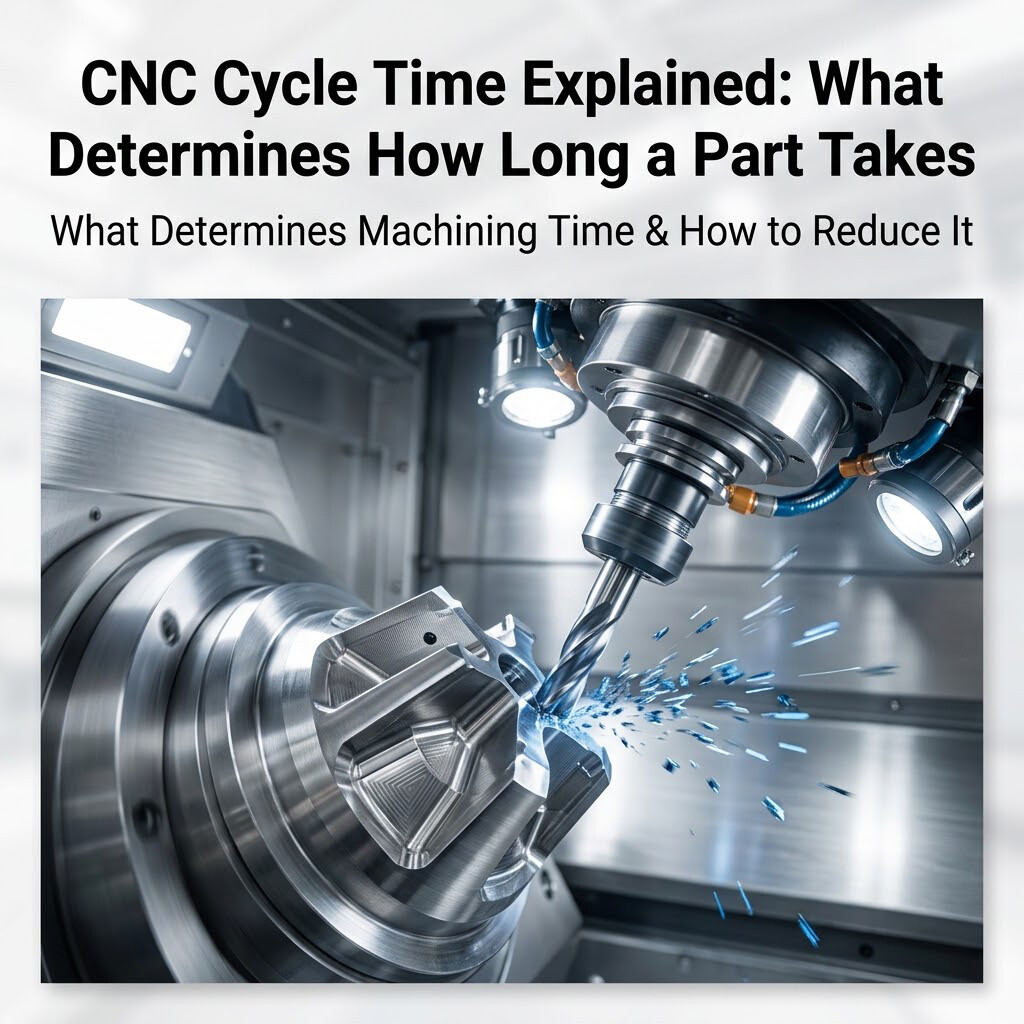
Guide 19: CNC Cycle Time Explained: What Determines How Long a Part Takes to Machine
An essential guide to understanding CNC cycle time, key influencing factors, and proven strategies to reduce machining duration and costs.
Guide 19: CNC Cycle Time Explained: What Determines How Long a Part Takes to Machine
What Determines Machining Time & How to Reduce It | Manufacturing Academy
1. Introduction
One of the first questions customers ask after receiving a CNC quote is: "Why does this part take so long to machine?"
The answer lies in cycle time—the total time required for a CNC machine to produce one finished part. Cycle time directly impacts manufacturing cost, machine capacity, and delivery schedules. Even small reductions in machining time can generate significant savings, especially in medium- and high-volume production.
2. What Is CNC Cycle Time?
Cycle time is the total time a CNC machine spends producing one complete part, from the moment machining begins until the finished component is removed. Depending on the manufacturing process, cycle time may include spindle cutting time, tool changes, rapid positioning moves, probing/measurement, machine pauses, and automatic pallet changes (if applicable). It does not usually include programming, fixture design, or machine setup for the first part.
3. Why Cycle Time Matters
Every minute a CNC machine is running has a cost. Longer cycle times mean higher machining costs, lower production capacity, longer lead times, and increased machine utilization. Reducing cycle time improves production efficiency, part cost, delivery speed, and manufacturing competitiveness.
4. The Main Factors That Affect Cycle Time
Part Complexity
Complex geometries require more machining operations, such as multiple pockets, curved surfaces, intricate contours, numerous drilled holes, and undercuts.
Material Type
Different materials machine at different speeds:
Material | Relative Machining Speed |
Aluminum | Very fast |
Brass | Fast |
Mild steel | Moderate |
Stainless steel | Slower |
Titanium | Slow |
Inconel | Very slow |
Material Removal Volume
The more material that must be removed, the longer machining takes. For example, removing 90% of a solid aluminum block takes much longer than lightly finishing a near-net-shape casting.
Number of Operations & Tool Changes
Each operation (facing, rough milling, finish milling, drilling, tapping, reaming, chamfering, engraving) adds time. Every tool change pauses machining, which can add up to several minutes per cycle.
Machine Movements
Machines also spend non-cutting time positioning, retracting, changing tools, probing, rotating rotary axes, and accelerating or decelerating.
5. How Part Design Influences Cycle Time
• Deep Pockets: Require longer tools, multiple roughing passes, and slower cutting parameters.
• Small Internal Corners: Require small end mills that remove material slowly.
• Excessively Tight Tolerances: Require finishing passes, slower feeds, and additional inspection.
• Numerous Hole Sizes: Increase tool changes. Standardizing hole sizes reduces cycle time.
• Thin Walls: Require lighter cutting parameters to prevent vibration and deformation.
6. Roughing vs. Finishing Time
Roughing: Goal is to remove material as quickly as possible using high material removal rates, larger tools, deeper cuts, and faster feeds.
Finishing: Creates final dimensions and surface quality using shallow cuts, slower feed rates, and improved accuracy control.
7. How Manufacturers Reduce Cycle Time
Shops optimize processes using high-efficiency toolpaths (adaptive machining), optimized tool selection, combined multifunction tooling, better fixturing, and automation (pallet changers, robotic loading).
8. Design Tips to Reduce Cycle Time
• Use standard drill sizes whenever possible.
• Avoid unnecessarily deep pockets.
• Increase internal corner radii.
• Minimize the number of unique hole diameters.
• Specify realistic tolerances.
• Avoid non-functional decorative features.
• Design parts that can be machined in fewer setups.
• Keep wall thickness practical for the material.
9. Cycle Time vs. Lead Time
Factor | Cycle Time | Lead Time |
Definition | Time to machine one part | Total time from order to delivery |
Measurement | Minutes or hours | Days or weeks |
Impacted By | Machining strategy, geometry, tooling | Scheduling, setup, materials, inspection, shipping |
10. Conclusion & Key Takeaways
Cycle time is one of the biggest contributors to CNC machining cost. Designing with manufacturability in mind significantly reduces machining time without compromising part performance.
11. Frequently Asked Questions
Q: Does a larger CNC machine reduce cycle time?
A: Not necessarily. Spindle performance, tooling, and programming strategy usually have a greater impact on machining time.
Q: Why do small features increase machining time?
A: Small features require smaller cutting tools, which remove material more slowly and need lighter cutting parameters.
Q: Can CAM software reduce cycle time?
A: Yes. Modern CAM software optimizes toolpaths, minimizes air cutting, and improves cutting efficiency.
Q: Is shorter cycle time always better?
A: Not always. Excessively aggressive machining can reduce tool life or compromise part quality. Balance is required.