
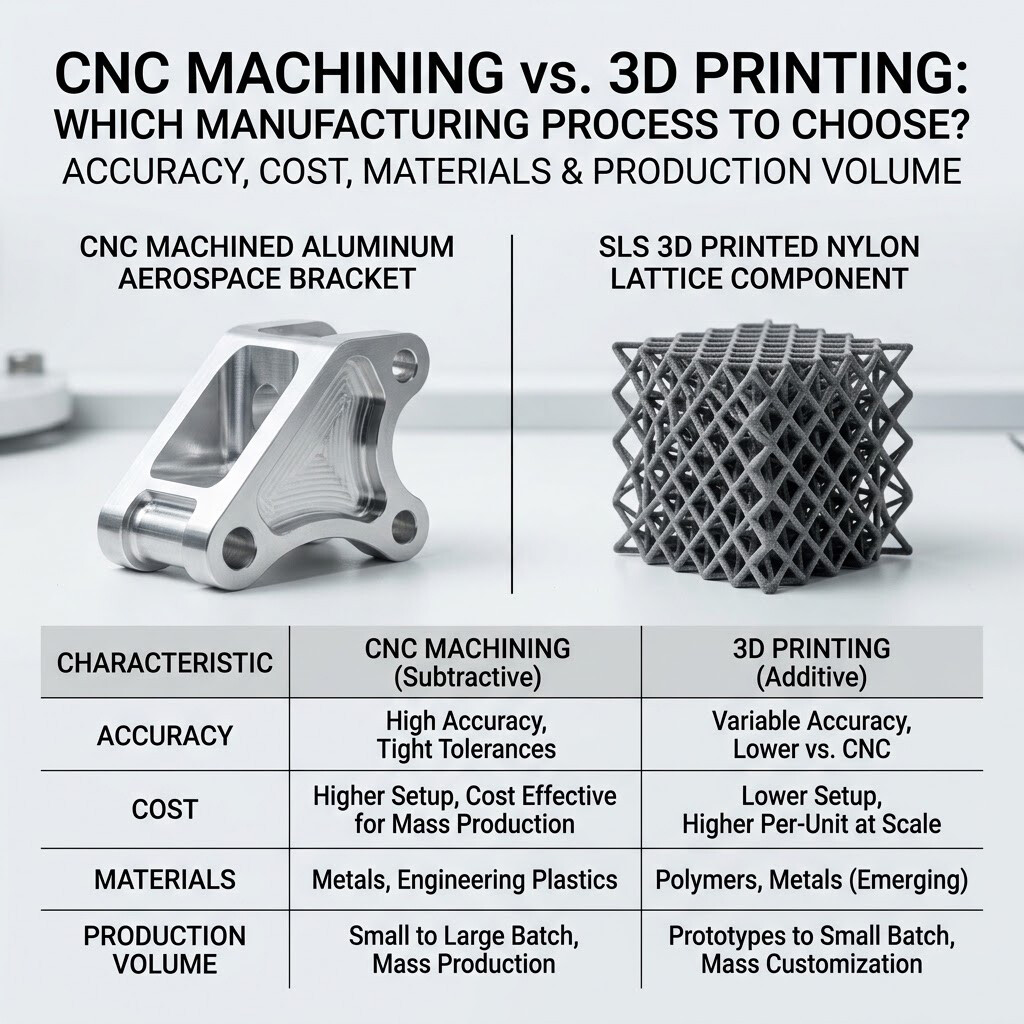
Guide 20: CNC Machining vs. 3D Printing: Which Manufacturing Process Should You Choose?
This guide compares CNC machining and 3D printing across accuracy, cost, materials, and production volume to help engineering teams choose the right manufacturing process.
Guide 20: CNC Machining vs. 3D Printing: Which Manufacturing Process Should You Choose?
Accuracy, Cost, Materials & Production Volume | Manufacturing Academy
1. Introduction
CNC machining and 3D printing are two of the most widely used manufacturing technologies today. Both can produce complex parts quickly, but they solve different manufacturing challenges. Choosing the wrong process can increase costs, delay production, or result in parts that don't meet performance requirements.
2. CNC Machining vs. 3D Printing: The Basic Difference
CNC Machining: Subtractive manufacturing process where a cutting tool removes material from a solid block. Common materials: aluminum, stainless steel, steel alloys, brass, copper, titanium, and engineering plastics.
3D Printing: Additive manufacturing process where material is deposited layer by layer. Common materials: PLA, ABS, Nylon, PETG, Resin, and metal powders.
3. Comparison at a Glance
Factor | CNC Machining | 3D Printing |
Manufacturing Method | Subtractive | Additive |
Dimensional Accuracy | Excellent (±0.02 mm to ±0.05 mm) | Good to excellent (±0.1 mm to ±0.3 mm) |
Surface Finish | Excellent naturally | Usually requires post-processing |
Material Strength | Full material isotropic strength | Depends on printing technology |
Material Options | Very wide range of metals & plastics | More limited |
Complex Internal Geometry | Limited | Excellent |
Production Speed | Fast after setup | Fast for complex prototypes |
High-Volume Production | Excellent | Generally less suitable |
Material Waste | Higher | Lower |
4. Key Comparison Criteria
Material Selection
CNC machining provides full material properties across aluminum alloys, stainless steel, carbon steel, titanium, brass, copper, PEEK, Delrin (POM), Nylon, PTFE, Acrylic, Polycarbonate, etc. 3D printing offers PLA, ABS, PETG, TPU, Resins, and metal powders (DMLS/SLM), but printed parts may have anisotropic layer strength.
Dimensional Accuracy & Surface Finish
CNC achieves tight tolerances (±0.02 mm to ±0.05 mm) and smooth finishes. 3D printing yields ±0.1 mm to ±0.3 mm and exhibits visible layer lines requiring post-processing (sanding, vapor smoothing).
Design Freedom
3D printing shines for complex geometries like internal lattice structures, conformal cooling channels, and organic shapes that cannot be machined conventionally.
Production Volume & Cost
CNC machining offers lower unit cost as production volumes increase. 3D printing is cost-effective for concept models, design verification, and customized one-off prototypes.
Lead Time
3D printing produces initial simple prototypes in 24–48 hours. CNC prototype delivery typical lead time is 3–7 days.
5. When Should You Choose Which Process?
Choose CNC Machining When:
• High dimensional accuracy and tight tolerances are needed
• Excellent native surface finish is required
• Full mechanical strength and isotropic properties are required
• Standard engineering metals or plastics are specified
• Production quantity is beyond a few dozen parts
Choose 3D Printing When:
• Extremely complex or enclosed internal geometries are needed
• Rapid 24–48 hour design iterations are required
• Lightweight lattice structures are used
• One-off customized parts or visual concept models are needed
6. Combined Hybrid Workflow
Many development teams print initial concept models for rapid fit checks, then transition to CNC machining for functional testing and production.
7. Conclusion & Key Takeaways
Neither CNC machining nor 3D printing is universally better. Choose based on your specific priorities: precision, strength, surface finish, complexity, volume, and cost.
8. Frequently Asked Questions
Q: Is CNC machining more accurate than 3D printing?
A: Yes. CNC machining generally achieves tighter dimensional tolerances and better repeatability.
Q: Is 3D printing cheaper than CNC machining?
A: For one-off prototypes with complex geometry, yes. For functional parts and higher production volumes, CNC machining is usually cheaper per part.
Q: Can metal parts be 3D printed?
A: Yes. Industrial additive systems can print stainless steel, aluminum, titanium, etc., but equipment and post-processing are significantly more expensive.
Q: Which process is better for production?
A: For most low- to medium-volume production and precision components, CNC machining remains the more practical and cost-effective solution.