
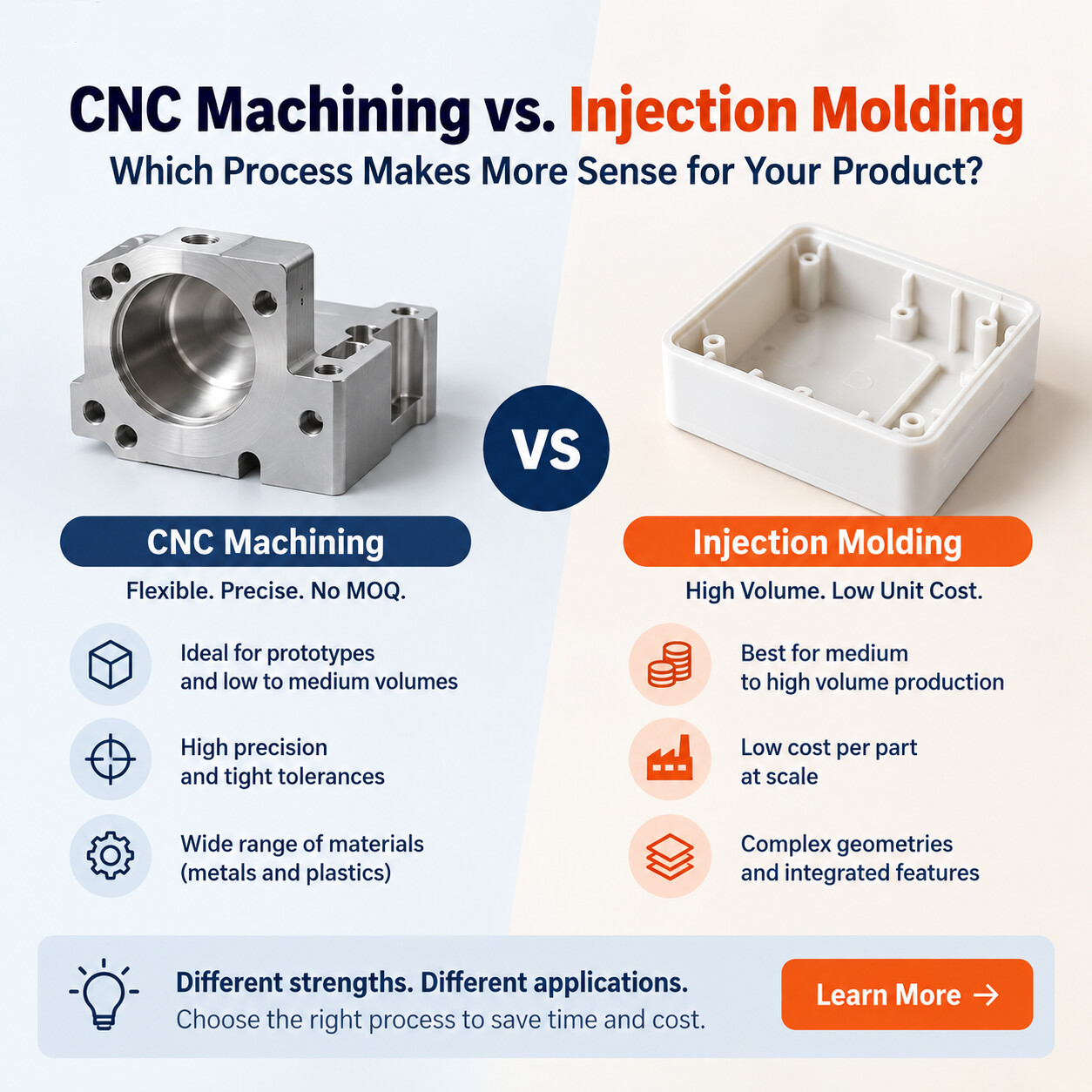
Guide 21: CNC Machining vs. Injection Molding: Which Process Makes More Sense for Your Product?
This guide compares CNC machining and injection molding across cost, speed, production volume, material options, and design flexibility, helping manufacturers choose the optimal process for prototyping and mass production.
Guide 21: CNC Machining vs. Injection Molding: Which Process Makes More Sense for Your Product?
Cost, Speed, Volume & Design Flexibility | Manufacturing Academy
You've designed a new product and are ready to manufacture it—but one critical question remains:
Should you machine the parts from solid material, or invest in injection molding?
Both CNC machining and injection molding are widely used in manufacturing, but they serve very different purposes. Choosing the wrong process can significantly increase costs, extend lead times, or limit future scalability.
In this guide, we'll compare the two manufacturing methods across cost, speed, accuracy, materials, production volume, and design flexibility so you can confidently choose the best solution for your project.
1. Understanding the Two Processes
CNC Machining
CNC machining is a subtractive manufacturing process. Material is removed from a solid block using precision cutting tools until the final geometry is achieved.
Common materials include:
· Metals: Aluminum, Stainless steel, Brass, Titanium
· Engineering plastics: PEEK, Delrin, Nylon, PTFE
Each part is individually machined.
Injection Molding
Injection molding creates parts by injecting molten plastic into a precision mold under high pressure. After cooling, the mold opens and ejects the finished component. Once the mold is built, identical parts can be produced extremely quickly.
2. Quick Comparison
Factor | CNC Machining | Injection Molding |
Initial investment | Low | High (tooling required) |
Per-part cost | Higher | Very low at scale |
Best production volume | 1–1,000 pcs | 5,000+ pcs |
Lead time | Days | Weeks for tooling |
Design changes | Easy | Expensive |
Material options | Metals + plastics | Plastics only |
Precision | Very high | High |
Surface finish | Excellent | Excellent |
Complex internal features | Easy | Mold-dependent |
3. Production Volume Is Usually the Biggest Decision
For most projects, production quantity determines the best manufacturing process.
Low Volume (1 – 200 parts)
Typical quantities: 1 part, 10 parts, 50 parts, 200 parts. CNC machining is almost always the better choice because there is no tooling investment.
Medium Volume (500 – 3,000 parts)
Either process may be suitable depending on part complexity, material, cost target, and product lifecycle. Many companies still choose CNC machining during early production.
High Volume (5,000+ parts)
Typical quantities: 5,000, 10,000, 100,000+, or Millions. Injection molding becomes dramatically more economical because tooling cost is spread across many parts.
4. Tooling Cost Comparison
One of the biggest differences is upfront investment.
· CNC Machining: No dedicated tooling required. You simply upload your CAD model and begin production. Benefits include no mold cost, immediate revisions, and faster product iteration.
· Injection Molding: Requires a custom steel or aluminum mold. Typical tooling costs range from several thousand to tens of thousands of dollars, depending on part size, number of cavities, mold complexity, surface finish requirements, and slider/lifter mechanisms. The mold is usually the largest initial expense.
5. Which Process Is Faster?
CNC Machining
For prototypes: CAD review → Programming → Machining → Inspection → Shipping. Many parts can be delivered within days.
Injection Molding
Before production begins: Mold design → Mold manufacturing → Mold validation → Sample approval. This process often takes several weeks. Once approved, production becomes extremely fast—thousands of parts can be produced in a single day.
6. Material Selection
CNC Machining Supports
· Metals: Aluminum, Steel, Stainless steel, Brass, Copper, Titanium
· Plastics: ABS, Delrin, Nylon, PEEK, PTFE, Polycarbonate, Acrylic
Injection Molding Supports
Primarily thermoplastics, including: ABS, Polypropylene (PP), Polycarbonate (PC), Nylon (PA), POM (Delrin), TPU, HDPE, PET, PPS. Metal components generally require CNC machining or other manufacturing methods.
7. Design Flexibility
This is where CNC machining shines. Changing a design only requires updating the CAD model—no expensive tooling modifications are needed. This makes CNC ideal for product development, functional testing, engineering validation, custom products, and frequent design revisions.
Injection molding is less flexible. Even small design changes may require mold rework, new inserts, additional machining, or entirely new tooling, adding both cost and delay.
8. Surface Finish & Tolerances
· Surface Finish: CNC machining offers precision-machined surfaces, bead blasting, brushing, anodizing, powder coating, and polishing. Injection molding can directly produce glossy finishes, matte textures, molded grain, SPI finishes, and VDI textures. Surface quality depends largely on mold finish.
· Tolerances: CNC machining generally provides tighter dimensional control, with typical tolerances of ±0.01–0.05 mm. Injection molding typically achieves ±0.05–0.20 mm. Shrinkage during cooling must also be considered when designing molded parts.
9. Cost Example
Imagine a plastic enclosure:
· 100 pieces: Option A (CNC machining) requires no tooling, resulting in higher unit cost but lowest overall investment. Option B (Injection mold) requires high tooling cost, making overall project cost much higher.
· 10,000 pieces: The mold cost is spread across every unit, making injection molding dramatically cheaper per unit than CNC machining.
10. Industry Applications
· Industries Preferring CNC: Aerospace, Medical devices, Robotics, Semiconductor equipment, Industrial automation, Scientific instruments, Automotive prototyping. These industries value precision and flexibility over maximum production speed.
· Industries Preferring Injection Molding: Consumer electronics, Household appliances, Packaging, Toys, Automotive interiors, Consumer goods, Wearable devices. These industries rely on high-volume, repeatable production.
11. Can You Use Both?
Absolutely—and many successful products do. A typical product development path looks like this:
· CNC-machined prototype
· Functional testing
· Design improvements
· Pilot production using CNC
· Injection mold development
· Mass production with molding
This approach minimizes risk while accelerating product development.
12. Common Mistakes
· Paying for expensive molds before validating the design
· Using CNC for hundreds of thousands of identical plastic parts
· Ignoring tooling lead time
· Designing molded parts without proper draft angles
· Assuming one process is always cheaper
13. Conclusion
CNC machining and injection molding are not competing technologies—they're complementary. If you need speed, flexibility, precision, or low-volume production, CNC machining is usually the smarter option. If you're producing thousands of identical plastic parts, injection molding delivers the lowest cost per unit and exceptional production efficiency.
Key Takeaways
· CNC machining is ideal for prototypes, custom parts, and low-volume production.
· Injection molding requires higher upfront tooling costs but excels in high-volume manufacturing.
· CNC supports both metals and plastics, while injection molding is primarily for thermoplastics.
· Design changes are quick and inexpensive with CNC but can be costly after a mold is built.
· Many products use CNC for development before switching to injection molding for mass production.