
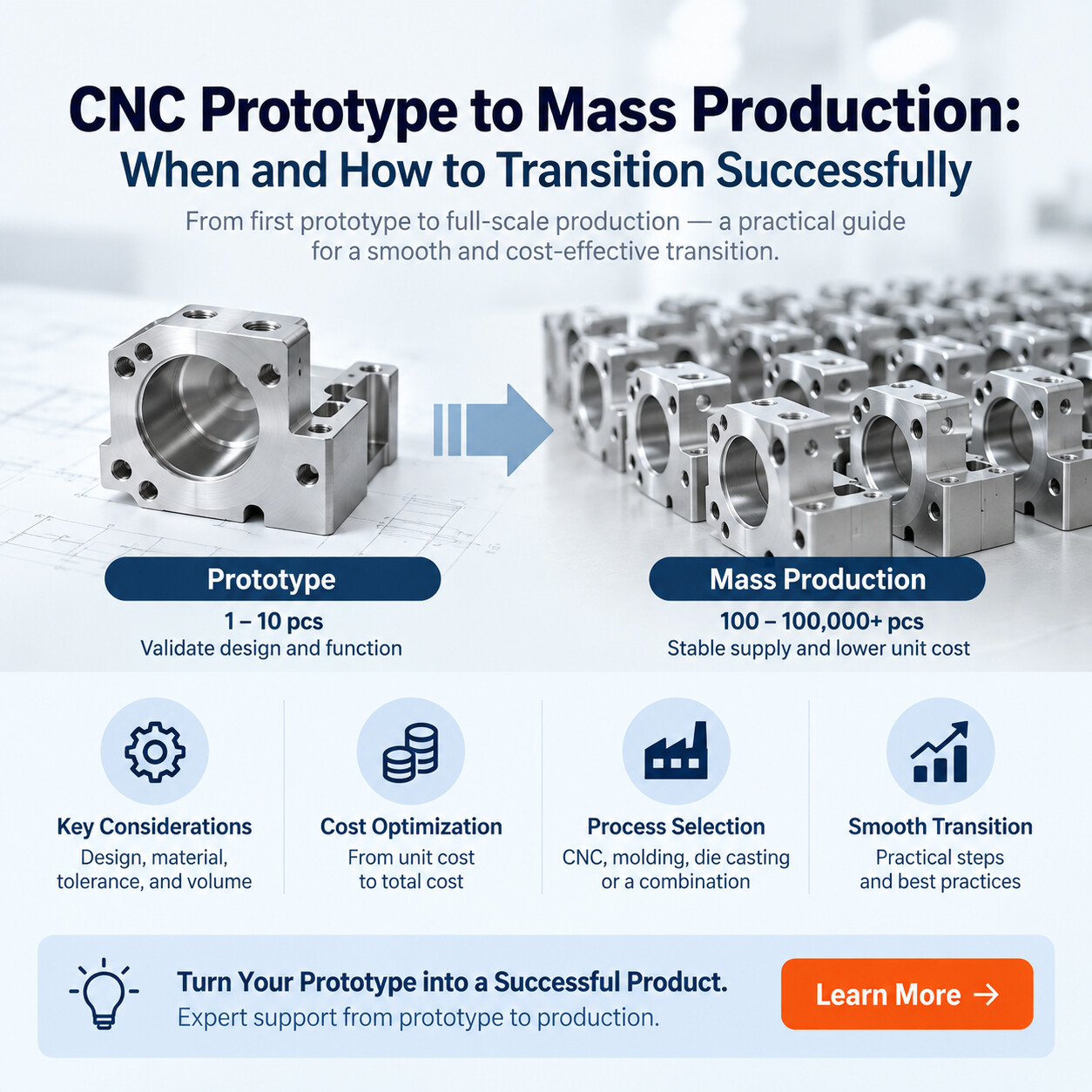
Guide 22: CNC Prototype to Mass Production: When and How to Transition Successfully
Transitioning from a successful CNC prototype to mass production requires careful planning, DFM optimization, and process scaling. This comprehensive guide outlines when to transition, key design changes, pilot production strategies, and how to manage costs effectively as you scale.
Guide 22: CNC Prototype to Mass Production: When and How to Transition Successfully
When and How to Transition Successfully | Manufacturing Academy
Every successful product starts as a prototype. Whether you're developing a medical device, industrial component, consumer product, or automation equipment, the journey usually follows the same path:
Prototype → Testing → Design Optimization → Pilot Production → Mass Production
The challenge isn't making the first part—it's scaling from one successful prototype to thousands of consistent, cost-effective components. Many companies discover that a design perfect for prototyping becomes expensive, slow, or difficult to manufacture at production volumes.
In this guide, we'll explain when it's time to move beyond prototyping, what changes are typically required, and how to transition smoothly into production without sacrificing quality or increasing costs.
1. What Is a CNC Prototype?
A CNC prototype is an early version of a product manufactured to validate:
· Fit
· Function
· Assembly
· Performance
· Appearance
· Manufacturability
The goal isn't to produce the cheapest part—it's to reduce uncertainty before committing to larger production runs. Because CNC machining uses production-grade materials, prototypes closely represent the final product, making them ideal for real-world testing.
2. The Typical Product Development Journey
Stage | Primary Goal |
Prototype | Verify the concept |
Engineering Validation | Confirm functionality |
Design Optimization | Improve manufacturability |
Pilot Production | Validate manufacturing process |
Mass Production | Deliver consistent parts at scale |
Skipping any of these stages can introduce costly problems later.
3. Detailed Development Stages
Stage 1: Functional Prototyping
At this stage, the focus is speed. Engineers want answers to questions such as: Does the design work? Do components fit together? Are tolerances appropriate? Is the material suitable? Can the product be assembled easily? Design revisions are expected, so flexibility is more important than minimizing machining costs.
Stage 2: Engineering Validation
Once the prototype performs as expected, testing becomes more rigorous. This may include: strength testing, fatigue testing, thermal evaluation, environmental testing, assembly verification, and customer evaluation. Multiple design iterations are common before final approval.
Stage 3: Design for Manufacturing (DFM)
This is where many projects achieve significant cost savings. Rather than asking, "Can this part be machined?", the question becomes: "Can this part be manufactured efficiently hundreds or thousands of times?"
Common DFM improvements include:
· Increasing internal corner radii
· Standardizing hole sizes
· Reducing unnecessary tolerances
· Simplifying pockets
· Eliminating deep cavities
· Selecting standard cutting tools
4. Signs You're Ready for Production
Your project is likely ready to transition when:
· The design has stabilized.
· Functional testing is complete.
· Customer feedback has been incorporated.
· Material selection is finalized.
· Assembly has been verified.
· Expected production volume is defined.
5. What Changes During Production?
Production machining is more than simply making more parts. Manufacturers optimize every aspect of the process:
· Machining Strategy: Programs are refined to reduce cycle time, improve tool life, increase consistency, and minimize machine downtime.
· Tooling: Production often uses dedicated fixtures, custom soft jaws, specialized cutting tools, and multi-part workholding to increase efficiency and reduce setup time.
· Quality Control: Inspection processes become systematic, including First Article Inspection (FAI), in-process inspection, final inspection, Statistical Process Control (SPC), and traceability documentation when required.
6. Managing Costs & Common Challenges When Scaling
One common misconception is that production costs decrease automatically with larger quantities. In reality, cost reduction comes from process optimization: shortening machining cycles, improving toolpaths, reducing setups, purchasing materials in bulk, using dedicated fixtures, and standardizing operations.
Common challenges during scaling include:
· Excessively Tight Tolerances: Specifications that were acceptable for a prototype may unnecessarily increase machining time and inspection costs.
· Complex Features: Features that are easy to machine once may become inefficient when repeated thousands of times.
· Long Cycle Times: Saving even one minute per part has a major impact across large volumes.
· Material Availability: Production requires reliable, long-term material supply chains.
7. Pilot Production: The Bridge to Mass Production
Before launching full-scale production, many companies produce a pilot batch (typically 20, 50, 100, or 500 parts). Pilot production verifies process stability, inspection procedures, assembly efficiency, packaging, shipping, and customer acceptance. Identifying problems here is far less expensive than during mass production.
8. Alternative Manufacturing Processes & Choosing a Partner
As production volume increases, CNC machining may transition to other processes such as injection molding (high-volume plastic), die casting (aluminum), metal stamping (sheet metal), or extrusion (constant profiles).
Working with the Right Partner: Look for a supplier offering prototype machining, DFM feedback, material guidance, pilot production, scalable capacity, consistent quality control, and ongoing engineering support throughout the product lifecycle.
9. Conclusion
The transition from prototype to production is one of the most important stages in product development. A successful prototype proves that your design works. A successful production process proves that it can be manufactured consistently, efficiently, and economically.
Key Takeaways
· CNC prototypes validate function, fit, and performance before production.
· Design for Manufacturing (DFM) helps reduce machining costs and improve efficiency.
· Pilot production bridges the gap between prototypes and full-scale manufacturing.
· Production machining requires optimized tooling, fixtures, and quality control.
· A manufacturing partner that supports the entire product lifecycle can simplify scaling and accelerate time to market.