
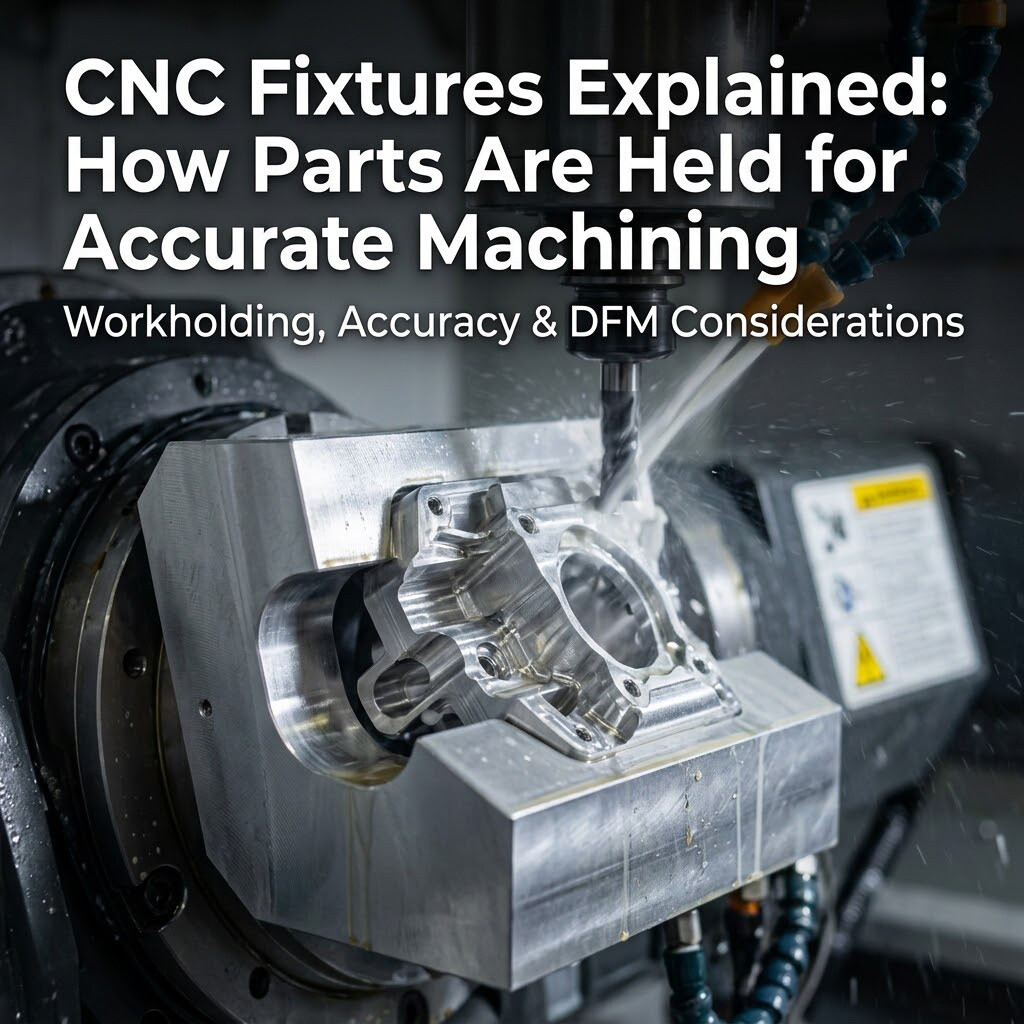
Guide 17: CNC Fixtures Explained: How Parts Are Held for Accurate and Efficient Machining
CNC fixtures play a critical role in machining accuracy, repeatability, surface quality, and production efficiency. This guide explains how CNC workholding works, the 3-2-1 locating principle, common fixture types, and how good DFM decisions can reduce setups, deformation, machining time, and overall production costs.
Guide 17: CNC Fixtures Explained: How Parts Are Held for Accurate and Efficient Machining
Workholding, Accuracy & DFM Considerations | Manufacturing Academy
1. Introduction
Every CNC machine is only as accurate as the way the workpiece is held. Even the most advanced 5-axis machining center cannot produce precise parts if the workpiece shifts during cutting. That's why fixtures—also known as workholding devices—are among the most important elements in CNC manufacturing.
Understanding how fixtures work helps engineers design better parts, reduce production costs, and avoid unnecessary quality issues.
2. What Is a CNC Fixture?
A CNC fixture is a device used to securely locate and clamp a workpiece during machining. Its job is to ensure the part:
• Stays perfectly still
• Remains in the correct position
• Resists cutting forces
• Can be repeatedly machined with high accuracy
Without proper fixturing, parts may move during cutting, vibrate excessively, lose dimensional accuracy, develop poor surface finishes, or require expensive rework.
3. Why Fixtures Matter
Every machining operation generates cutting forces. Depending on the material and machining strategy, these forces may reach hundreds or even thousands of newtons. If the fixture cannot resist those forces, dimensions drift, holes become misaligned, flat surfaces become uneven, chatter marks appear, and tools wear faster.
A rigid fixture improves dimensional consistency, repeatability, surface quality, tool life, and machining efficiency.
4. The Three Functions of a Fixture
A good fixture performs three essential tasks:
Locate the Part
The fixture establishes the part's exact position. This ensures every workpiece begins machining from the same reference location. Without accurate positioning, hole locations shift, pockets become offset, and tolerances stack up. The fixture determines whether the machine can achieve its full precision.
Clamp the Part
Once located, the part must be clamped firmly. The clamping force should prevent movement, avoid deformation, and distribute pressure evenly. Too little force causes movement, while too much force may distort thin parts. Finding the right balance is critical.
Support the Part
Thin or flexible components may bend during machining. Support points reduce deflection and vibration. Proper support is especially important for thin plates, long brackets, large aluminum parts, and plastic components.
5. The 3-2-1 Locating Principle
One of the most common fixture design methods is the 3-2-1 principle. The idea is to remove all six degrees of freedom using:
• 3 points to support the bottom surface
• 2 points to locate one side
• 1 point to locate the remaining side
This simple approach fully defines the part's position while avoiding over-constraint. It is widely used in precision machining and inspection fixtures.
6. Common Types of CNC Fixtures
Standard Vise
The most common workholding method. Ideal for blocks, plates, and prototype parts. Advantages include quick setup, low cost, and versatility. Limitations include limited access to multiple sides.
Soft Jaws
Soft jaws are custom-machined jaws that match the geometry of a specific part. Advantages include improved gripping, reduced deformation, higher repeatability, and better cosmetic protection. Commonly used in production machining.
Vacuum Fixtures
Vacuum fixtures hold flat parts using suction. Common applications include aluminum sheets, plastics, and composite panels. Advantages include no clamp interference, excellent surface accessibility, and fast loading. However, vacuum holding force is limited compared with mechanical clamping.
Modular Fixtures
Modular fixtures use standardized locating pins, blocks, and clamps. Benefits include flexibility, reduced fixture cost, and quick reconfiguration. Suitable for low-volume and mixed-product manufacturing.
Dedicated Fixtures
High-volume production often uses dedicated fixtures designed for one specific part. Advantages include the fastest setup, highest repeatability, and shortest cycle times, with the downside of higher upfront tooling cost.
7. How Fixture Design Influences Machining Cost
Fixture design directly affects manufacturing efficiency. Poor fixturing may require multiple setups, manual repositioning, additional inspections, and slower cutting parameters. Good fixturing often enables fewer operations, shorter machining times, higher automation, and reduced labor costs. For production runs, fixture optimization can significantly reduce the cost per part.
8. Designing Parts That Are Easy to Fixture
• Include Flat Reference Surfaces: Flat surfaces provide stable locating areas. Irregular shapes are more difficult to fixture accurately.
• Avoid Extremely Thin Clamping Areas: Very thin walls may deform when clamped. If unavoidable, additional supports or custom jaws may be required.
• Provide Enough Clearance: Leave sufficient space for clamps and cutting tools. Avoid placing critical features immediately adjacent to clamping locations.
• Minimize the Number of Setups: Whenever possible, design parts so that multiple features can be machined in a single setup. Fewer setups generally improve accuracy while reducing machining time.
• Consider Tool Accessibility: The fixture should hold the workpiece without blocking tool access. If clamps interfere with machining, additional setups may become necessary.
9. Common Fixture-Related Problems
Problem | Likely Cause
|
Part movement | Insufficient clamping force |
Chatter | Low fixture rigidity |
Size variation | Poor locating accuracy |
Surface dents | Excessive clamping pressure |
Thin wall distortion | Unsupported features |
Long cycle times | Multiple setups required |
Many dimensional problems originate from fixturing rather than machine accuracy.
10. Fixture Design in High-Volume Production
As production quantities increase, fixture design becomes increasingly important. Custom fixtures can provide faster loading and unloading, consistent positioning, reduced operator error, compatibility with robotic automation, and shorter cycle times. Although dedicated fixtures require an upfront investment, they often deliver substantial savings over large production runs.
11. Conclusion & Key Takeaways
Proper fixturing is one of the foundations of successful CNC machining. A well-designed fixture accurately locates the workpiece, securely resists cutting forces, minimizes vibration, improves repeatability, reduces setup time, and lowers production costs. For designers, considering fixture requirements early in the design process often results in parts that are easier, faster, and more economical to manufacture.
12. Frequently Asked Questions
Q: Can the same fixture be used for every part?
A: No. While standard vises and modular fixtures suit many components, complex or high-volume parts often require custom fixtures for optimal accuracy and efficiency.
Q: Do custom fixtures always reduce costs?
A: Not always. For prototypes or low-volume production, a custom fixture may cost more than it saves. They become cost-effective when the setup savings are spread across many parts.
Q: Can improper fixturing damage a part?
A: Yes. Excessive clamping force can deform thin-walled parts, leave clamp marks, or introduce dimensional errors that remain even after machining.
Q: Why do manufacturers try to reduce the number of setups?
A: Every new setup introduces additional positioning error and increases labor time. Designing parts and fixtures that allow more machining in a single setup generally improves both accuracy and productivity.