Guide 06: CNC Surface Finish Options: Which One Is Right for Your Part?
Beyond dimensional accuracy, a CNC part's surface finish dictates its appearance, corrosion resistance, and wear performance. Choosing the correct finish prevents unnecessary production costs while ensuring your part meets exact functional and aesthetic demands.
Guide 06: CNC Surface Finish Options: Which One Is Right for Your Part?
Surface Treatments, Ra Roughness & DFM Guidelines | Manufacturing Academy
After a CNC part is machined, its surface condition can be just as important as its dimensional accuracy. The right surface finish can improve appearance, corrosion resistance, wear performance, and product durability. The wrong choice may add unnecessary cost without providing additional value. Selecting the appropriate finish depends on how the part will be used.
1. What Is a Surface Finish?
Surface finish describes the surface texture and post-machining condition of a component. Some parts are used directly after machining, while others receive additional chemical, mechanical, or secondary finishing processes to improve performance or appearance. The best option depends on functional requirements—not simply aesthetics.
2. Common CNC Surface Finish Options Overview
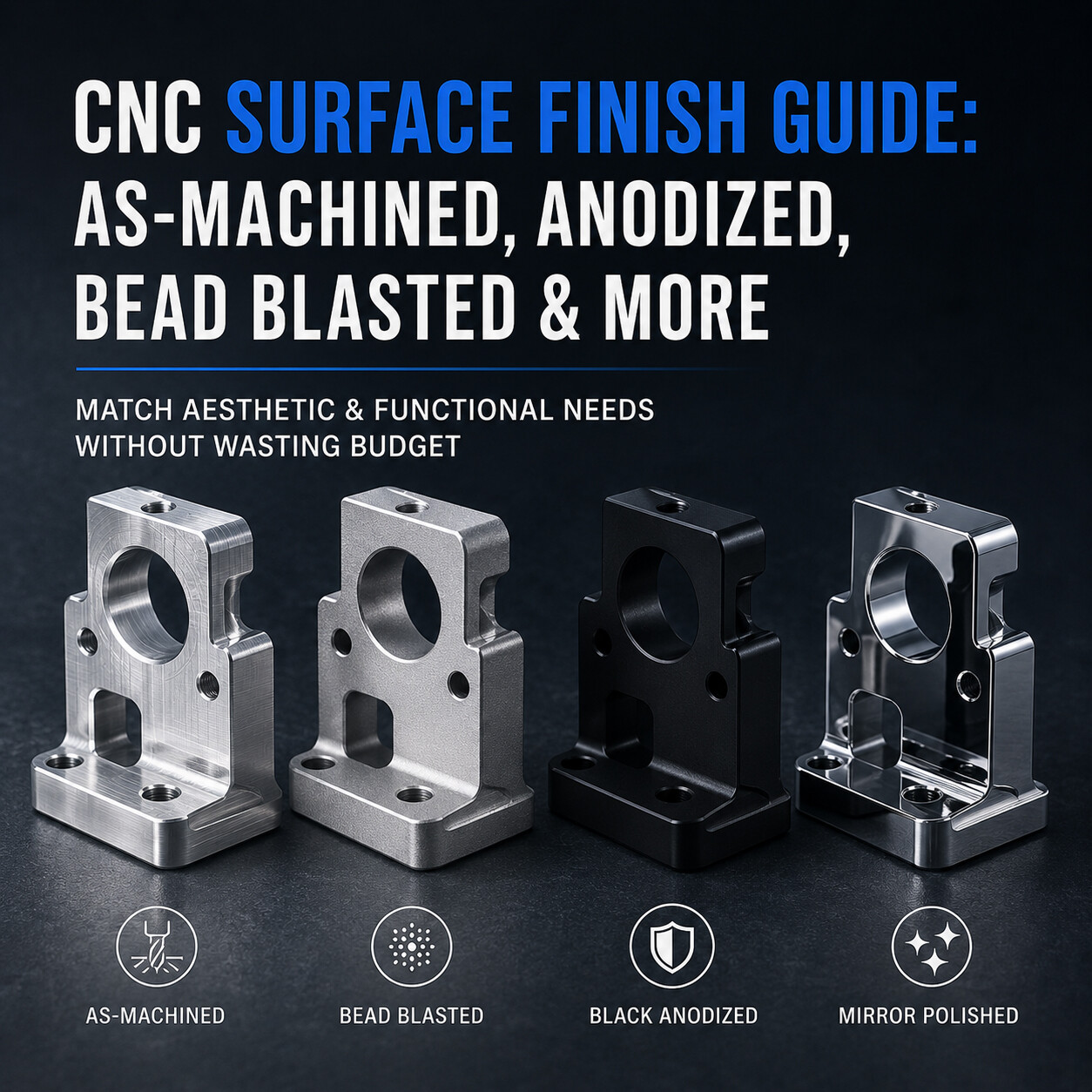
Surface Finish Option | Surface Roughness (Ra) | Relative Cost Impact | Primary Benefits & Applications |
As-Machined | 3.2 µm (125 µin) | Base Cost (Lowest) | Standard machine output; lowest cost, fastest delivery, excellent accuracy. |
Smooth Machined | 1.6 µm (63 µin) | Low (+10–15%) | Fine finishing passes; removes severe cutter marks, improves sealing faces. |
Bead Blasting | Satin Matte Texture | Low – Medium (+15–20%) | Uniform matte appearance; removes tool marks, ideal for enclosures. |
Anodizing (Type II) | N/A (Oxide Film) | Medium (+20–30%) | Corrosion resistance, wear protection, attractive colored finishes (Aluminum). |
Hardcoat Anodizing (Type III) | N/A (Thick Film) | Medium – High (+35–50%) | Exceptional surface hardness & wear resistance for severe industrial use. |
Powder Coating | Smooth / Textured | Medium (+25–35%) | Excellent impact resistance, wide color selection, heavy outdoor protection. |
Polishing / Mirror Finish | < 0.1 µm (4 µin) | High (+50–100%+) | Ultra-smooth mirror finish; optics, medical devices, sealing surfaces. |
3. Detailed Breakdown of Surface Treatments
As-Machined Finish
Delivered directly from the CNC machine with standard cutter paths visible.
Advantages: Lowest unit cost, fastest delivery schedule, preserves 100% original machining tolerance.
Suitable For: Internal structural components, internal brackets, fixtures, and non-cosmetic mechanical parts.
Bead Blasting
Fine glass media is blasted under air pressure against the part surface.
Advantages: Completely eliminates directional machining marks, produces a uniform satin matte texture, improves aesthetic appeal.
Suitable For: Consumer products, electronics housings, medical device exteriors, and visual assemblies.
Anodizing (Aluminum Alloys)
An electrochemical process that forms a protective aluminum oxide film on the component surface.
Benefits: Superior corrosion resistance, improved surface wear resistance, decorative color choices (Black, Clear, Blue, Red), electrical insulation.
Suitable For: Precision aluminum components, outdoor gear, aerospace fittings, and robotic components.
Powder Coating & Polishing
Powder Coating: Applies a durable protective polymer skin over metal surfaces. Offers strong impact resistance and heavy-duty corrosion protection.
Polishing: Reduces surface roughness to sub-micron levels. Used for optical reflectors, medical devices, and precision hydraulic sealing surfaces.
4. Does Every Part Need a Surface Treatment?
No. Many industrial components function perfectly in an as-machined state. Applying decorative or protective coatings where they are not required only increases manufacturing cost and lead time.
💡 Selection Guide: Match finish strictly to environment: Internal parts ➔ As-Machined | Cosmetic exteriors ➔ Bead Blast + Type II Anodize | Heavy wear surfaces ➔ Type III Hardcoat Anodize | Outdoor exposure ➔ Powder Coating.
5. Factors to Consider Before Choosing
Operating Environment: Exposure to moisture, chemicals, UV light, or outdoor elements.
Corrosion & Wear Resistance: Frictional sliding contact or harsh fluid exposure.
Product Appearance: Customer-facing visual surfaces vs. hidden internal structural parts.
Dimensional Coating Allowance: Accounting for anodize or powder coat thickness build-up on tight-tolerance holes.
6. How We Help Customers Choose
Conclusion & Key Takeaways
Functional Alignment: Surface finish directly affects both visual appearance and mechanical durability.
As-Machined Efficiency: As-machined components provide the most economical and timely solution for non-cosmetic parts.
Avoid Over-Finishing: Decorative coatings are unnecessary for internal features and add avoidable costs.
Expert Guidance: Selecting the right finish optimizes product longevity while maintaining manufacturing cost efficiency.
Next Guide in Series: Guide 07: Design for CNC Machining: 10 Mistakes That Increase Cost