
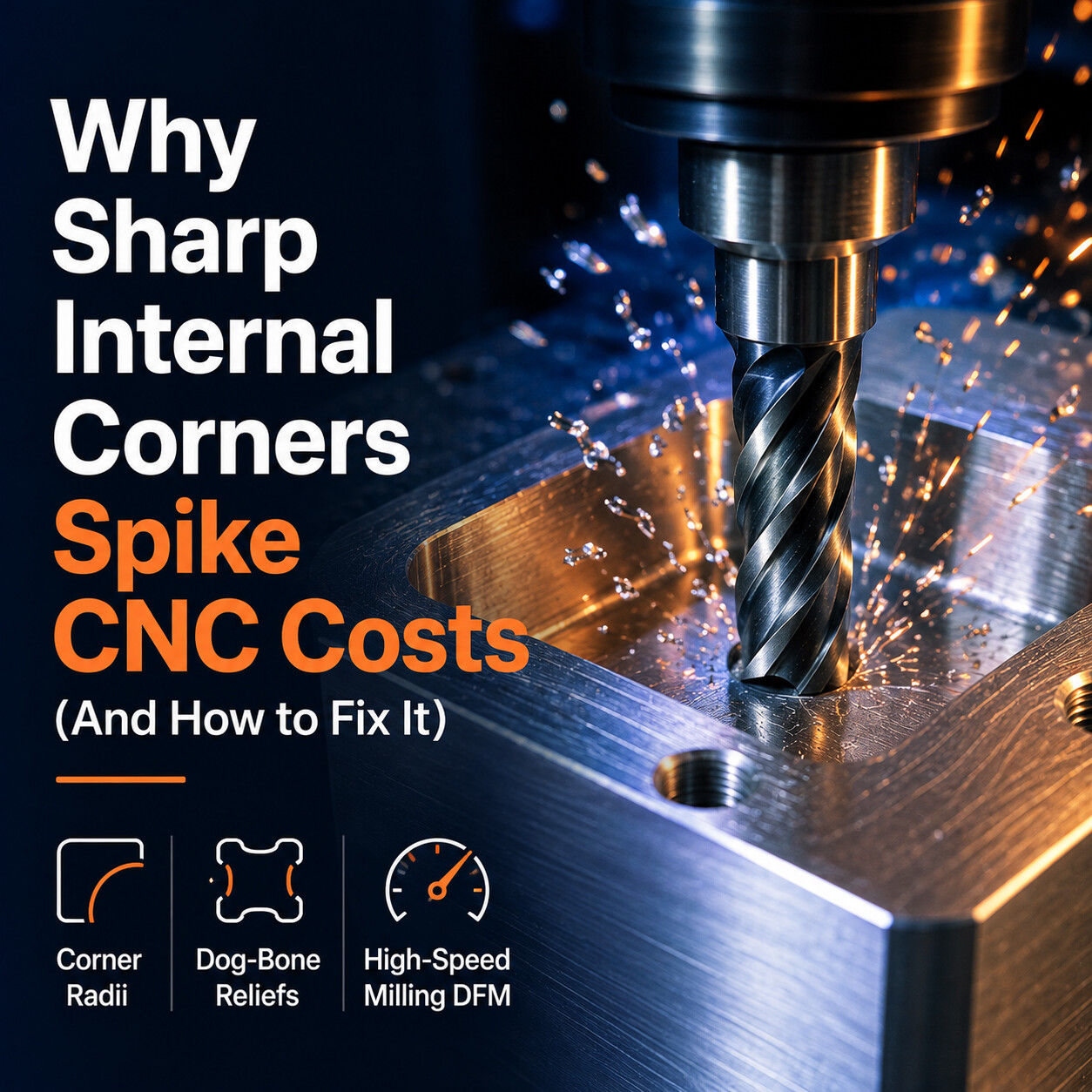
Guide 10: CNC Corner Radius vs. Sharp Internal Corners: What Designers Need to Know
Specifying sharp internal corners in CNC designs is impossible with standard rotating cutters. Achieving them requires slow micro-tools, EDM, or hand-finishing—significantly increasing costs and lead times.
Guide 10: CNC Corner Radius vs. Sharp Internal Corners: What Designers Need to Know
Corner Radius DFM, Dog-Bone Relief & Milling Efficiency | Manufacturing Academy
One of the most common design mistakes in CNC machining is specifying perfectly sharp internal corners. While sharp 90° corners look clean on a 3D CAD model, they are physically impossible to produce using standard rotating end mills. As a result, manufacturers must either use tiny cutting tools at slow speeds, perform secondary EDM operations, or manually finish corners—each of which significantly increases unit cost and lead time.
1. Why CNC Machines Cannot Milling Sharp Inside Corners
Because all CNC milling cutters are round, they naturally leave an internal corner radius equal to the radius of the tool. For example, a Ø10 mm end mill leaves an R5 mm radius, while a Ø6 mm tool leaves an R3 mm radius. Reducing the radius forces the machinist to drop down to smaller, less rigid cutters.
2. How Small Corner Radii Increase Manufacturing Cost
Smaller end mills suffer from reduced cutter rigidity, increasing tool deflection, vibration, and breakage risks. Machining deep pockets with tiny cutters requires shallow depth-of-cut passes at drastically reduced feed rates, exponentially increasing cycle time.
3. Recommended Pocket Depth to Corner Radius Ratio
Pocket Cavity Depth | Recommended Minimum Radius | Preferred Tool Diameter |
Depth < 10 mm | R2.0 – R3.0 mm | Ø4.0 – Ø6.0 mm End Mill |
Depth 10 – 25 mm | R3.0 – R5.0 mm | Ø6.0 – Ø10.0 mm End Mill |
Depth 25 – 50 mm | R5.0 – R8.0 mm | Ø10.0 – Ø16.0 mm End Mill |
Depth > 50 mm | As large as function allows | Ø16.0+ mm Heavy Cutter |
4. Dog-Bone Relief: A Smarter DFM Alternative
When a square mating component (such as a PCB, circuit block, or mounting key) must fit flush into a pocket, specify a 'Dog-Bone' or 'T-Bone' relief instead of sharp corners. This circular relief allows a standard end mill to clear the corner, enabling full square fitment without custom tooling.
💡 Dog-Bone Relief Advantage: Using dog-bone reliefs eliminates expensive Wire EDM operations and allows full high-speed milling, cutting pocket machining cost by up to 50%.
5. When Sharp Corners Are Truly Necessary
For applications like injection mold cavities, precision dies, or optical locating slots where sharp internal corners are mandatory, specialized secondary manufacturing processes must be used: Wire EDM, Sinker EDM, or Broaching. Recognize that these processes add handling and setup costs.
Conclusion & Key Takeaways
Embrace Radii: Design internal corners with the largest practical radius to maximize milling speeds.
Leverage Dog-Bones: Use dog-bone reliefs for square part fitments to avoid costly EDM.
Depth-to-Radius Balance: Keep corner radii proportional to pocket depth to prevent tool chatter and breakage.