
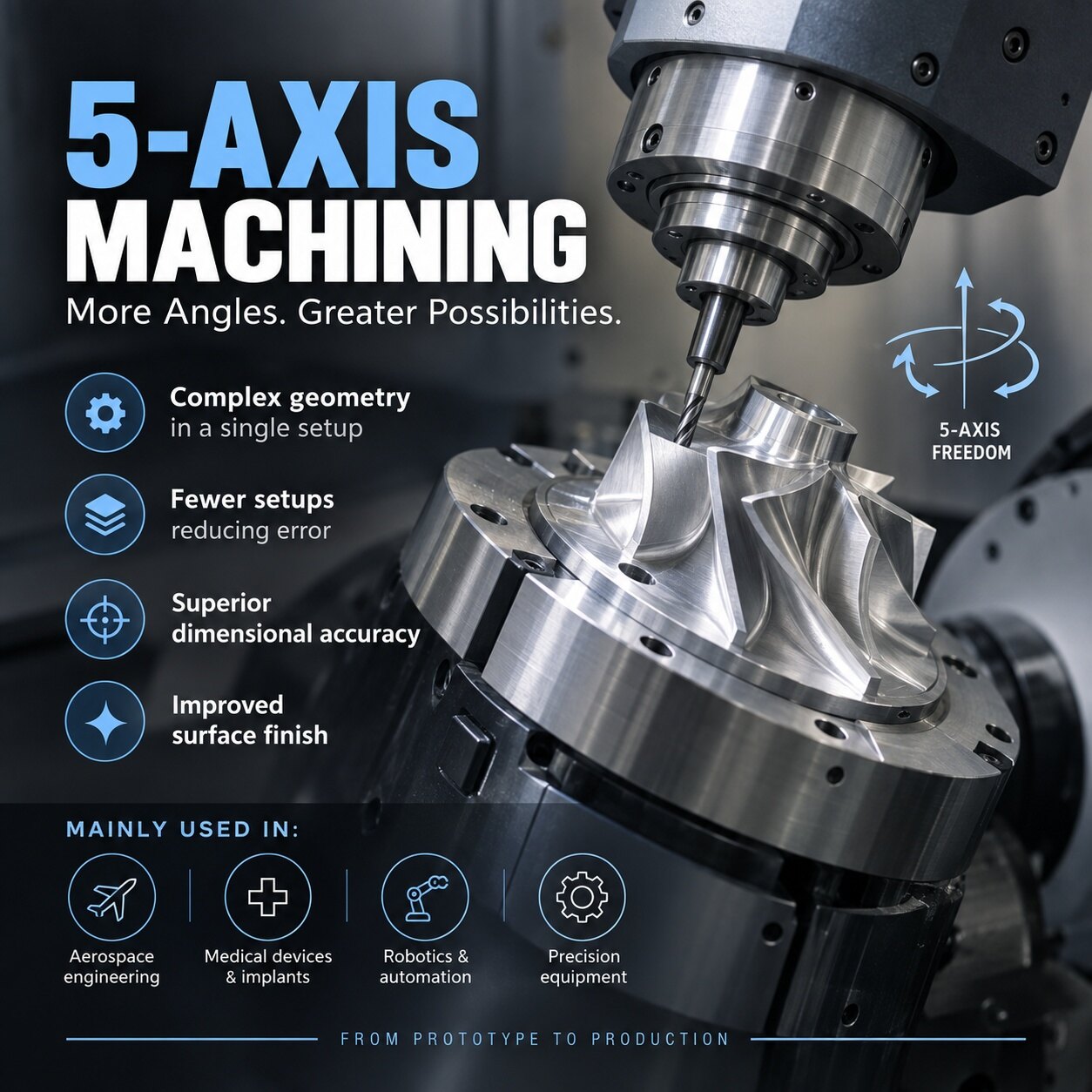
What Is 5-Axis Machining? Benefits, Applications, and Advanced Manufacturing
Explore how 5-axis CNC machining expands traditional 3-axis capabilities with multi-directional movement, delivering complex geometries, fewer setups, and superior surface finishes.
Understanding 5-Axis Machining: The Future of Precision Manufacturing
In modern precision engineering, traditional 3-axis CNC machining has long been a staple for flat and prismatic parts. However, as product designs grow increasingly intricate across aerospace, medical, and robotics sectors, manufacturing demands have evolved. This is where 5-axis machining becomes essential.
How 5-Axis Machining Works
Traditional CNC machining operates using three linear axes ($X$, $Y$, and $Z$) to move the cutting tool or workpiece across length, width, and depth. 5-axis machining adds two rotational axes (typically tilting and rotating around the table or spindle), allowing the tool to approach the part from any angle continuously.
Key Benefits of 5-Axis Technology
Complex Geometry: Seamlessly machine deep pockets, compound angles, and organic contours in a single operation.
Fewer Setups: Eliminate the need to manually reposition workpieces multiple times, reducing setup overhead and stack-up errors.
Better Accuracy & Finish: Utilize shorter cutting tools at optimal tilt angles to achieve exceptional surface finishes and precise dimensional tolerances.
Key Industrial Applications
Because of its unmatched versatility, 5-axis technology is widely utilized in high-stakes industries including aerospace component manufacturing, advanced medical device production, robotics systems, and high-precision mechanical equipment.
Complex parts require smarter manufacturing solutions. Integrating multi-axis capabilities into your production workflow ensures faster turnaround times, higher repeatability, and superior component quality.