
What Determines CNC Machining Cost? The 4 Key Factors Explained
Curious about what goes into your CNC machining quote? Discover the 4 primary factors—material, geometry, tolerance, and quantity—that drive CNC machining costs and learn how DFM optimization can help lower production expenses.
What Determines CNC Machining Cost?
Understanding how CNC machining costs are calculated is crucial for engineering and procurement teams looking to optimize budgets without compromising product performance. When you submit a CAD drawing for a quote, several variables influence the final price.
Smarter design leads to lower costs. By understanding the core cost drivers early in the design stage, you can make informed decisions that significantly reduce manufacturing expenses.
The 4 Key Cost Factors
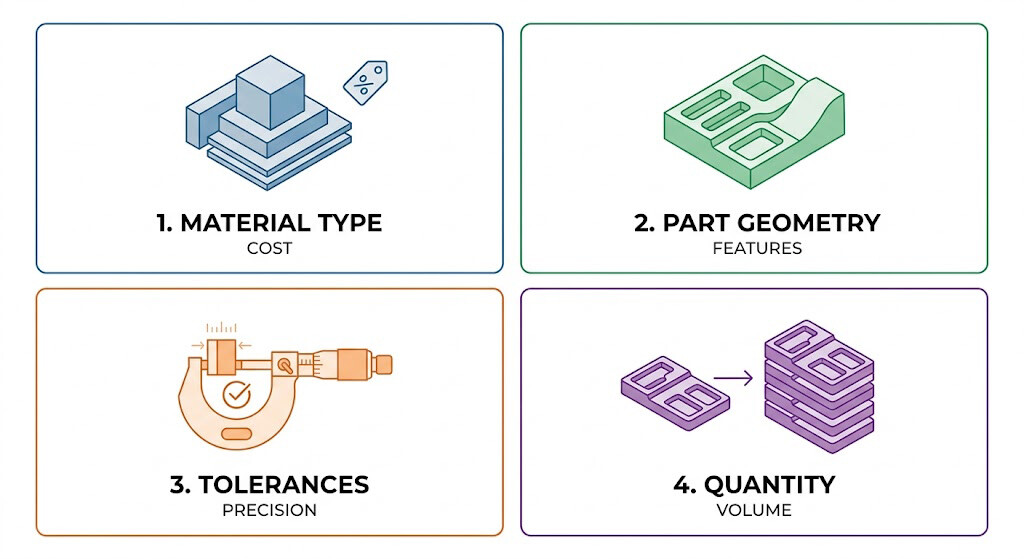
Material Selection: Raw material choice plays a major role in pricing. Harder or tougher materials, such as titanium or stainless steel, take significantly longer to machine and cause higher tool wear compared to softer metals like aluminum or brass.
Part Geometry: Complex designs with deep pockets, thin walls, curved surfaces, or tight internal corners require specialized tooling, multi-axis machining setups, and longer cycle times, which increase the overall cost per part.
Tolerances: Tighter tolerances demand higher machine precision, slower cutting speeds, frequent inspection checks, and strict quality control. Specifying precision tolerances only where strictly necessary helps keep machining costs manageable.
Production Quantity: Order volume directly impacts the unit price. Setup costs, programming time, and custom workholding fixtures are amortized across the entire order batch, meaning larger quantities usually result in a much lower cost per unit.
Optimize Your Design for Cost Efficiency
Small adjustments during the Design for Manufacturing (DFM) phase can lead to substantial savings. Working with an experienced manufacturing partner allows you to identify unnecessary complexities before committing to production.
At Bafang Hardware, we support customers from prototyping to full-scale mass production. Our end-to-end workflow combines:
Professional DFM Support: Analyzing your CAD files to eliminate unnecessary cost drivers.
Precision Machining: Delivering tight tolerances and superior surface finishes.
Seamless Scalability: Helping you bridge the gap efficiently from prototype to volume production.
Ready to Lower Your Production Costs?
Don't let design blind spots inflate your manufacturing budget.
Want this reviewed on your own part?
Upload your CAD file for a free DFM review. Our engineering team will assess manufacturability, material and process options, and cost drivers for your design.
Get a Free DFM Review